

 Dirty Bird Bakersfield
AR Parts and Accesories, AR-15, AR-15 Triggers
Single Stage vs Two Stage Trigger: The AR-15 Trigger Buying Guide
Oct
Table of Contents
TL;DR- Too Long Didn’t Read
The right AR-15 trigger depends on how the rifle will be used, not on which design is “better.” A single-stage trigger breaks in one continuous press, while a two-stage trigger adds a light take-up before a crisp final break.
- Home-defense and duty rifles should run a standard fire control group at roughly 4.5 pounds or heavier.
- Precision shooters tend to prefer a two-stage pull, while competition shooters favor a light single-stage cassette with a short reset.
- Drop-in cassettes install easily, but standard groups are easier to inspect and clean on a defensive rifle.
- Mil-spec triggers typically break between 5.5 and 8.5 pounds and remain a sound, affordable choice.
Few questions come across our counter more often than the single stage vs two stage trigger debate, and most buyers asking it have already been told which answer is correct. Someone made the case with total confidence, and the buyer arrives expecting us to confirm it. After years of talking with shooters about triggers, our answer has not changed. Neither design is better in the abstract, and the right trigger is the one that matches what the rifle is for.
That is why we steer buyers toward three decisions instead of brand arguments. The first is how the trigger breaks, which is the stage question. The second is whether it installs as a drop-in cassette or a standard fire control group, and the third is the shape of the shoe, after which pull weight and reset usually fall into place.
Three Decisions That Shape Every Trigger Choice
Start with the job. A home-defense or duty rifle should carry a standard-pattern single-stage or two-stage group at roughly 4.5 pounds or heavier, because a rifle used under stress needs a pull that resists a startled finger. A precision rifle generally rewards a two-stage pull that lets the shooter settle the reticle before a small final press. A competition rifle tends to favor a light single-stage cassette with a short reset.
A budget range rifle is the easiest call, because a polished single-stage group with good springs delivers most of the improvement a new owner wants. Shoe shape is personal and gets its own section below. Our selection of AR-15 triggers covers each of those uses, so the single stage vs two stage trigger decision carries over to the shelf.
Single Stage vs Two Stage Trigger: How Each One Breaks
What Is a Single-Stage Trigger?
A single-stage trigger releases the hammer in one continuous press, with pressure building from the moment the finger meets the shoe until the sear lets go. Any movement before the break is creep rather than a stage, and a good single-stage trigger has very little of it. The standard mil-spec AR-15 trigger is a single-stage design, which is why so many shooters describe the pull on their first rifle as long, heavy, and gritty.
What Is a Two-Stage Trigger?
A two-stage trigger divides the press into two parts. The first stage is a light, smooth take-up that moves the trigger rearward until it meets a firm stop, which shooters call the wall. The second stage is the break, and because the first stage has already absorbed part of the weight, the final press feels lighter than the number on the box suggests.

How a Two-Stage Trigger Works: Take-Up, Wall, and Break
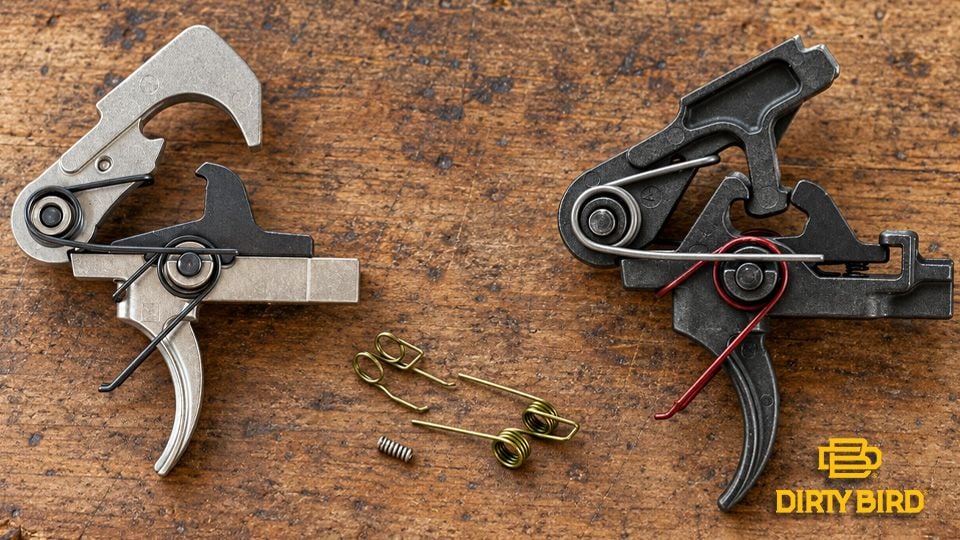
Our Dirty Bird 2-Stage Trigger Group shows how the weights stack. With the standard trigger spring the first stage runs about 1.5 pounds, and the included black Extra Power spring raises it to roughly 2 pounds. The second stage breaks at about 2.5 pounds, so the total lands between 4 and 5 pounds. RTT: Guns & Gear shows that take-up and wall on a recce-style build in its review at https://www.youtube.com/watch?v=TQ6lSfuayDE. The Geissele 2 Stage G2S at $175 follows the same idea at about 4.5 pounds total, while the Geissele SSA-E at $250 lightens both stages to roughly 3.5 pounds for marksman rifles, according to Geissele’s specifications.

Single Stage vs Two Stage Trigger: Which Fits the Rifle?
The single stage vs two stage trigger choice comes down to how the rifle is shot. A single-stage pull suits fast strings, quick transitions, and shooters who want the break the moment they commit, which is why it dominates competition rifles. A two-stage pull suits deliberate shots, positional shooting, magnified optics, and home-defense carbines, where the wall gives the finger a clear signal before the rifle fires. Shooters who cannot decide should try both, because no spec sheet captures preference.
Reset and Why Follow-Up Shots Feel Different
Reset is the forward travel the trigger needs after a shot before it can fire again. When the bolt carrier cocks the hammer, the disconnector catches it, and letting the trigger move forward hands the hammer back to the trigger sear with the click shooters feel and hear. A standard AR-15 trigger has a fairly long reset, while quality cassettes shorten it and make it more tactile.
A shorter reset speeds follow-up shots because the finger travels less, though it only helps a shooter who has practiced riding it. Two-stage triggers reset positively too, but the rhythm feels more deliberate. That difference is one of the most practical parts of the single stage vs two stage trigger comparison.
Drop-In Cassette or Standard Fire Control Group?
A drop-in trigger is a self-contained cassette, with the trigger, hammer, disconnector, and springs assembled inside a housing. Installation means drifting out the factory pins, setting the unit in place, and securing it, usually with included anti-walk pins. A standard fire control group is a set of individual parts pinned into the receiver, which takes more care to install but generally costs less and comes apart with a cartridge tip.
Our Dirty Bird AR-15 Single Stage Quick Reset Drop-In Trigger delivers a 3.5-pound single-stage pull from a hardcoat anodized aluminum housing. Its S7 tool steel internals carry a black nitride finish, and it ships with anti-walk pins for $143.99. Like the Rise Armament RAVE 140 at $99.95 and the CMC Single Stage 3.5 lb at $174, it belongs on range, competition, and precision rifles, where a light break and a quick reset pay off.
For a defensive rifle we lean the other way, and so does ARBuildJunkie in its guide to AR-15 trigger types. Cassettes can hold debris inside the housing, many use reduced hammer springs that may struggle with hard military primers, and they are harder to service in the field. Our defensive pick is the 2-Stage group or a quality standard trigger at a sensible weight, while our drop-in triggers go to rifles built for the range.

Flat vs Curved Trigger Shoes
The shoe is the only part of the trigger the shooter touches, so its shape changes how the pull weight feels. A curved shoe, the traditional M4 shape, centers the finger in the bow and feels familiar. A flat shoe lets the finger rest lower on the blade, farther from the pivot, where it has more leverage, so the same spring weight can feel lighter. Flat shoes suit competition and precision rifles where finger placement must be identical every shot, while curved shoes remain common on duty rifles. Our Quick Reset drop-in and 2-Stage group both come in either shape, which settles the flat vs curved trigger question without changing triggers.
Pull Weight: How Light Is Too Light?
Mil-spec triggers generally break between 5.5 and 8.5 pounds. The ALG Defense ACT at $82.95 keeps that tradition on purpose, holding its pull at or above the 5.5-pound M4/M16 minimum while polishing away the grit. Two-stage combat triggers usually total around 4.5 pounds, and competition cassettes commonly run 2.5 to 3.5 pounds.
A defensive rifle stays heavier for two reasons. A startled finger can fire a light trigger before the shooter decides to, and the reduced hammer springs behind very light pulls can cause light strikes on hard primers. We would rather see a home-defense carbine with a clean 4.5-pound two-stage or a smooth 5.5-pound single-stage than a 3-pound cassette that only feels wonderful at the bench.

Where Mil-Spec Still Makes Sense
A mil-spec group is still the baseline the market is measured against, and for a hard-use rifle it remains a sound choice. It is inexpensive, field-serviceable, and built to function dirty, even if the pull is heavier and rougher. We cover that comparison in Dirty Bird Trigger vs Mil-Spec AR-15 Triggers, including when the upgrade is worth the money.
Where Our Own Fire Control Groups Fit
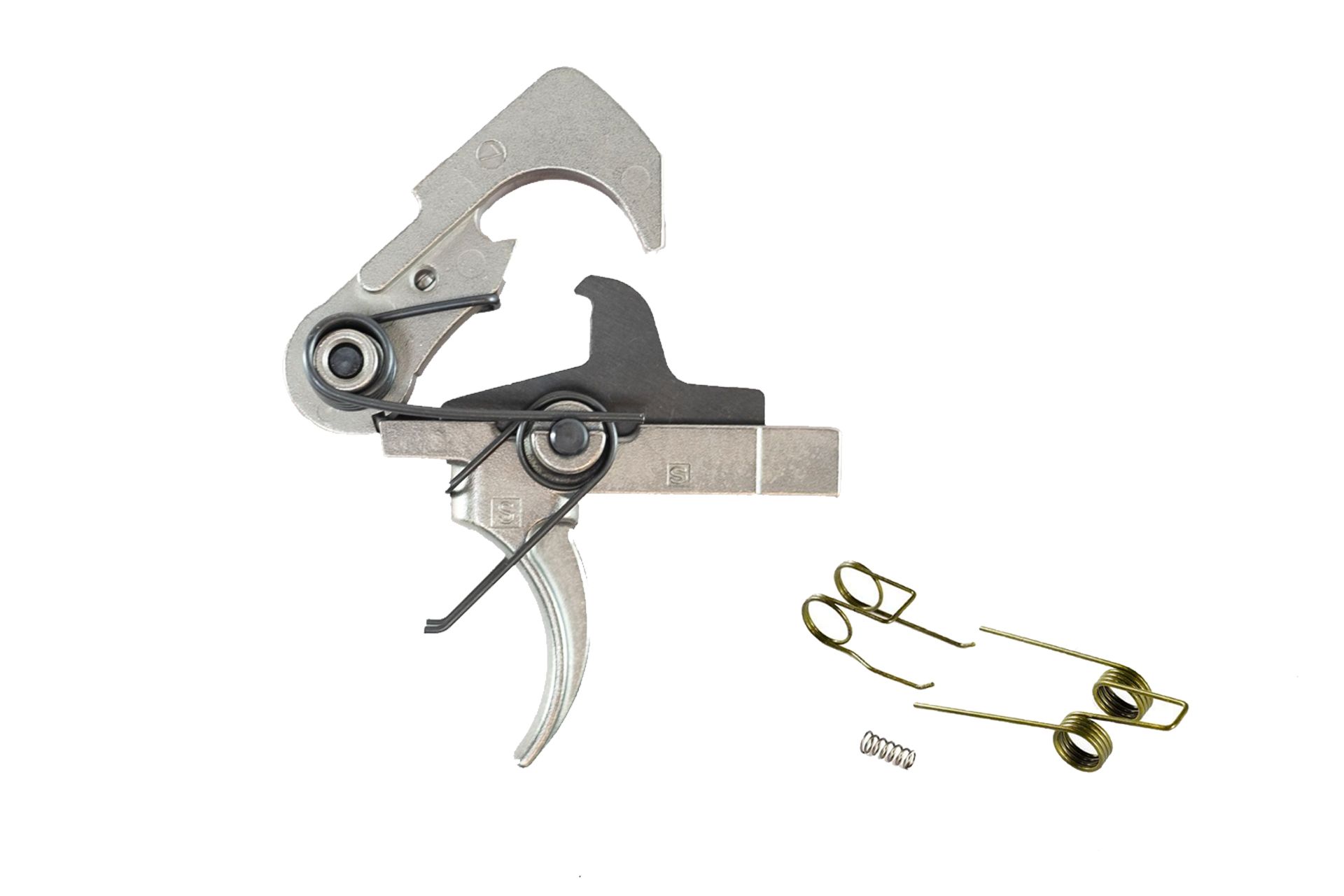
The Dirty Bird Industries Single Stage Nickel Teflon Trigger Group at $39.95 is our answer for the budget range rifle. Honed engagement surfaces and a Nickel Teflon finish smooth the single-stage pull, and the included reduced power springs bring it to a clean 5 to 5.5 pounds. It is 100% American made and backed by the Dirty Bird Limited Lifetime Warranty.
The Dirty Bird 2-Stage Trigger Group, at $89.95 curved and $134.95 flat, is our defensive and general-purpose pick, made in the USA and backed by the same Limited Lifetime Warranty. The Quick Reset drop-in at $143.99 covers range, competition, and precision rifles. Between the three, most buyers can settle the single stage vs two stage trigger decision without leaving our own lineup.
Common Questions About the Single Stage vs Two Stage Trigger
Is a two-stage trigger better than a single-stage?
Neither is better in every rifle. A two-stage suits deliberate shots and defensive carbines, while a single-stage suits fast strings and competition. Match the trigger to the rifle’s job, and the single stage vs two stage trigger question usually answers itself.
What are the advantages of a two-stage trigger?
The take-up and wall let the shooter prepare the shot and break it with a small, predictable press. The total weight stays high enough for a defensive rifle while the final stage still feels light. Few single-stage designs offer both at once.
Is a two-stage trigger good for home defense or action shooting?
For home defense, a quality two-stage at about 4.5 pounds is one of our preferred setups. For action shooting, many competitors prefer a light single-stage with a short reset. Some still run two-stage triggers well on the clock with practice.
Does the AR-15 come with a single or two-stage trigger?
Most factory AR-15 rifles ship with a standard mil-spec single-stage trigger. Some premium rifles come with two-stage units installed. Check the specifications of the model in question.
How do you adjust a two-stage trigger?
Many two-stage combat triggers, including the Geissele models above, are not adjustable. Our 2-Stage group changes its first stage weight by swapping in the included Extra Power spring, while adjustable models use set screws. Follow the manufacturer’s instructions and function-check the rifle afterward.
Flat or curved trigger: which is better?
The better shape is the one that puts the finger in the same place every time. Flat shoes add leverage and suit precision and competition rifles, while curved shoes feel familiar on duty and general-purpose builds. The choice is about feel rather than performance.
Can you lighten an AR-15 trigger pull?
Yes. On a single-stage group, our Reduced Power Single Stage Spring Set at $9.95 can bring the pull to roughly 4 to 5 pounds depending on the trigger, though it is not designed for two-stage triggers. Keep defensive rifles at a sensible weight, avoid polishing through hardened surfaces, and confirm reliable ignition with the rifle’s ammunition.
Buy the Break You Will Actually Train With
The buyers we see happiest with a trigger upgrade rarely bought the lightest or most expensive unit on the wall. In our experience, they decided what the rifle was for, picked a trigger that suited it, and trained until the break became second nature. Every new trigger feels different, and that adjustment period is where the real improvement happens.
Our rule of thumb is short. A rifle that might ever defend a home gets a standard-pattern single-stage or two-stage trigger at about 4.5 pounds or heavier, and a rifle built for groups or the clock can take a light cassette with a short reset. Settle the single stage vs two stage trigger question that way, then compare the Dirty Bird triggers on our shelves, look over the Dirty Bird Industries lineup, and choose the break you are willing to train with.