

 Dirty Bird Bakersfield
Shotguns
Best Home Defense Shotguns: Pump and Semi-Auto Picks
Nov
Table of Contents

TL;DR- Too Long Didn’t Read
The best home defense shotguns run reliably, fit the shooter, and put buckshot where you aim. This guide compares the pump and semi-auto models we carry and covers ammo, fit, accessories, training, and California rules.
- Pumps cost less and cycle almost any load, but they take practice to run under stress.
- Gas semi-autos soften recoil and speed up follow-up shots for households with several users.
- Use buckshot, not birdshot, and pattern it from your own gun.
- A weapon light is the first accessory to add.
- In California, configuration decides legality, and the 14-inch Shockwave is a short-barreled shotgun.
The best home defense shotguns share a short list of traits. They run every time, they fit the person holding them, and they put a full load of buckshot where the shooter is looking. That description covers a basic Mossberg pump and a premium Italian semi-auto alike, which is why the pump versus semi-auto argument never seems to end.
This guide covers how to pick an action, the ten pump and semi-auto shotguns we carry and recommend, ammunition, fit, accessories, training, and the California rules that decide which configurations you can buy here.
Why a Shotgun Still Makes Sense for Home Defense
Most home defense encounters happen across a room or down a hallway. Steve “Yeti” Fisher of Sentinel Concepts, talking with ARBuildJunkie, puts the typical case at one or two threats at seven to ten yards. At that distance, a standard 00 buckshot shell puts eight or nine pellets on target with a single pull of the trigger, and very few defensive tools deliver that much per shot.
A shotgun is also simple to learn at the level most households need. That combination of power and simplicity is why the best home defense shotguns still earn a spot in so many closets.
Shotguns do have tradeoffs. They kick harder than an AR-15, they carry fewer rounds, and topping off one shell at a time is slow. We compare the two platforms in AR-15 vs. Shotgun, and Fisher covers the same question from an instructor’s side in the two ARBuildJunkie conversations below.
Pump or Semi-Auto for Home Defense
Ask five instructors whether a pump or a semi-auto belongs in the bedroom closet and you will hear both answers. The right choice depends on the person holding it at three in the morning.
A pump action runs on the shooter’s arm. With no gas system or inertia spring to tune, it cycles light target loads, heavy magnum buckshot, and everything in between. Pumps also cost far less. Their weak point is the shooter. Short-stroking the forend under stress can leave an empty chamber or a shell half in the action, and only practice fixes that.
A semi-auto uses gas or recoil energy to load the next shell. Follow-up shots come faster and most gas guns kick noticeably less. The price is cost and a pickier diet. Some inertia guns need full-power loads to cycle, so every semi-auto should be tested with the exact defensive load you plan to keep in it.
Our rule at the counter is simple. If you will practice a few times a year and want the most gun for the money, buy a quality pump and learn to run it hard. If several people in the house will use the gun, or recoil is a concern for anyone, a reliable gas semi-auto is worth the extra cost.
Semi-Auto Home Defense Shotguns We Carry
These five semi-autos are among the best home defense shotguns we sell. Each is a 12 gauge with a fixed stock and a tube magazine in the configuration we list, which matters for California buyers.
Beretta 1301 Tactical Mod 2
The Beretta 1301 Tactical Mod 2 is the pick for shooters who want the fastest-cycling semi-auto they can buy. Beretta designed its B-Link gas system for speed, and the 1301 has earned a reputation among instructors and competitors as one of the quickest tactical shotguns on the market.
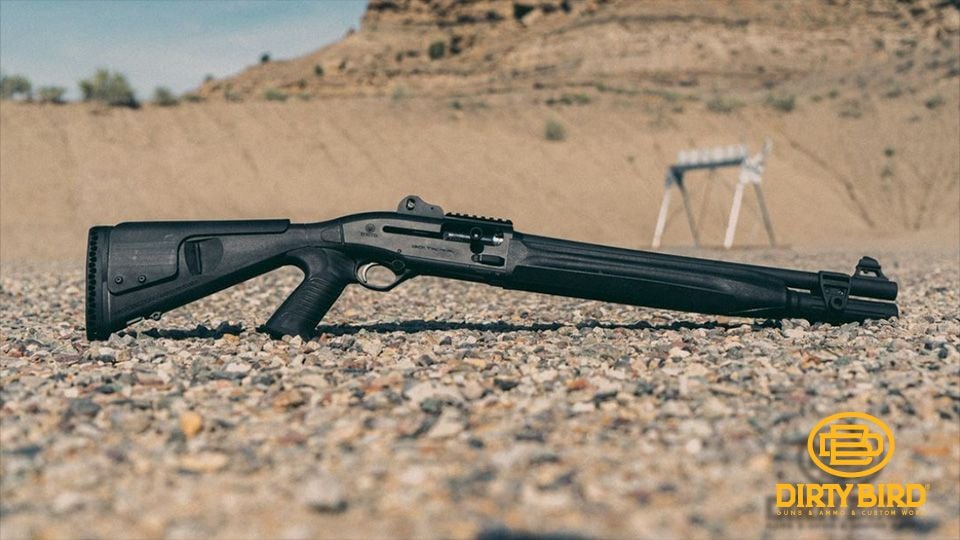
The Mod 2 we carry has an 18.5-inch barrel, a 7-round capacity, an M-LOK forend for mounting a light, and enlarged controls. We cover the Mod 2 changes in more detail in our Beretta 1301 Mod 2 overview.

Beretta A300 Ultima Patrol
The A300 Ultima Patrol is Beretta’s answer for shooters who like the 1301 but not its price. It uses a simpler gas system without B-Link, is built at Beretta’s plant in Tennessee, and shares a control layout close to the 1301’s. It is also one of our best-selling shotguns.
The cycling speed difference between the A300 and the 1301 shows up on a shot timer and is unlikely to matter in a hallway. Add a light and a sling and it is ready to work.

Mossberg 940 Pro Tactical
The Mossberg 940 Pro Tactical competes head to head with the A300. Our listing has it at 7+1 with an 18.5-inch barrel, with an enlarged loading port and a textured stock.
The A300 feels a little lighter in hand, while the 940’s stock gives more purchase during fast strings. The decision usually comes down to fit.

Benelli M4
The Benelli M4 carries more military history than anything else here. The U.S. Marine Corps adopted it as the M1014 around the turn of the century. Its ARGO system, short for Auto-Regulating Gas-Operated, uses two short-stroke pistons just ahead of the chamber, and Benelli describes the design as self-cleaning.
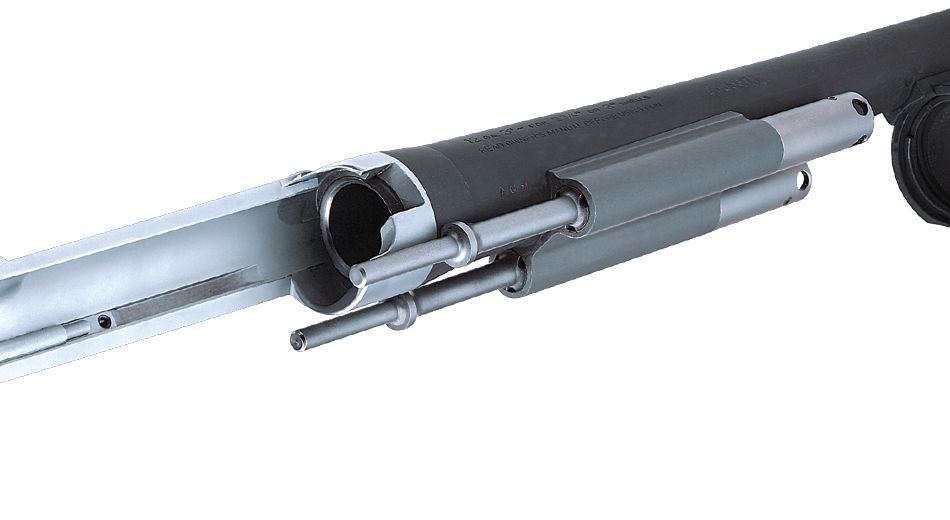
The version we carry pairs a fixed stock and pistol grip with an 18.5-inch barrel. For most buyers, the 1301 or A300 delivers similar performance in the house for considerably less money.

GForce Arms Gatlander
The GForce Gatlander is the budget semi-auto on this list and one of our top sellers. It runs on an inertia-driven action, which cycles from the rearward recoil of the gun itself. That keeps the action clean, but it also makes inertia guns more sensitive to light loads and to heavy accessories that change how the gun moves under recoil.
Run several boxes of your chosen buckshot through the Gatlander before you trust it at home. That applies to every semi-auto here, and most to the least expensive one.

Pump-Action Home Defense Shotguns We Carry
Mossberg fills this half of our best home defense shotguns list, and the reason is the Model 500. Designed by Mossberg chief engineer Carl Benson and first built in the early 1960s, the 500 family has passed 12 million sales by Mossberg’s count. Parts and accessories for it are everywhere.
Mossberg Maverick 88 Cruiser
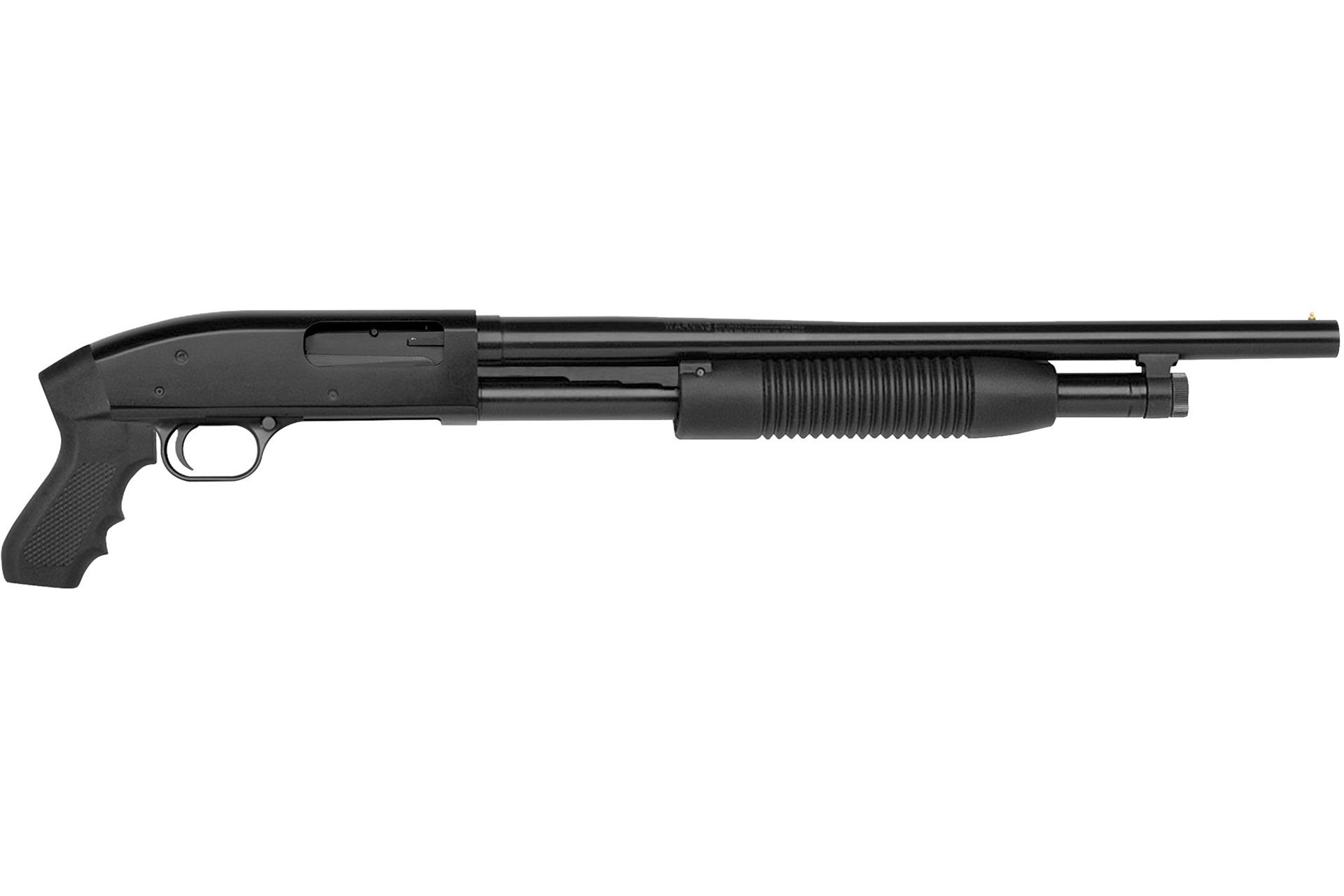
The Maverick 88 is one of the most popular shotguns we sell, and it does the basics at the lowest price on this page. Mossberg builds it as a simplified 500 with a cross-bolt safety in the trigger guard in place of the 500’s tang safety.
The Cruiser model we carry has an 18.5-inch barrel and a pistol grip in place of a buttstock. A pistol-grip-only shotgun is much harder to shoot accurately than one with a stock. Plan on adding a stock, or choose the Maverick 88 Security, which comes with a 20-inch barrel and a full synthetic stock.
Mossberg 590 Persuader
The 590 Persuader is a 20-inch, 8+1 duty pump with a heat shield over the barrel and a clean-out magazine tube. Mossberg ships it with a pistol grip conversion kit, but the full stock is the better choice for home defense.
Mossberg introduced the 590 in 1987 to win a military contract. Compared with the 500, it uses a clean-out magazine tube with a screw-off cap, which makes the tube easy to service, and its longer tube carries more shells under the barrel.

Mossberg 590 Shockwave
The 590 Shockwave is a 14-inch-barreled pump with a bird’s-head grip and a strapped forend. Federally, it is classified as a firearm rather than a shotgun because it was never designed to be fired from the shoulder, which is why it can ship with a barrel that short.
It suits a narrow role in tight spaces like apartments, boats, and RVs, where a full-length gun is awkward. It takes real practice to shoot well from chest level. California readers should see the California section below.

Mossberg 590S Tactical
The 590S Tactical solves the shell-length problem. Mossberg redesigned the elevator and bolt slide and added an energy-absorbing bumper, so the 590S cycles 1.75-inch, 2.75-inch, and 3-inch shells in any mix without an adapter.
Mossberg lists the 20-inch model at 7+1 with 3-inch shells, 8+1 with 2.75-inch shells, and 13+1 with 1.75-inch minishells. It has a ghost ring rear sight, an M-LOK forend, and a fixed stock with a 13.87-inch length of pull. California owners should read our note on minishells and tube capacity below.

Mossberg 590A1
The 590A1 is the heaviest-duty pump Mossberg makes. It adds a heavy-walled barrel, a metal trigger guard, and a metal safety button to the 590, and Mossberg rates it to MIL-SPEC 3443G. The 9-shot model we carry has a 20-inch Parkerized barrel, a bead sight, and an 8+1 capacity.
My own home defense shotgun is a 590A1. It weighs more than most pumps on this list, and in a gun that lives in the house and rarely leaves it, I will trade that weight for its reliability every time.

Birdshot and the Sound of a Racking Pump
Two pieces of shotgun folklore refuse to die. One says the sound of racking a pump will end the fight before it starts. Counting on that noise to scare someone off gives away your position, and a determined or impaired intruder may not care.
The other says birdshot is enough indoors because the spread does the aiming for you. At room distances, a cylinder-bore pattern is often about the size of a fist, so you still have to aim. Birdshot pellets are small and light, and they often fail to penetrate deeply enough to stop an attacker.
Even the best home defense shotguns are only as good as the shell in the chamber, and buckshot is the standard. 00 buck balances pellet size and penetration, while #1 buck has gained a following for packing more pellets. Federal FliteControl patterns very tightly, and Hornady’s Black and TAP loads open a little more. Winchester Ranger reduced-recoil buckshot is easier on smaller shooters.
Pattern whatever you choose. Shoot it on paper at five, seven, and ten yards from your own gun.
Gauge, Barrel Length, and Stock Fit
Twelve gauge is the default because it has the widest selection of defensive buckshot. Twenty gauge kicks noticeably less and still performs well at indoor distances, which suits smaller or recoil-sensitive shooters. Ask us about 20-gauge versions of the models below.
Barrel length is mostly settled. Most of the best home defense shotguns run 18.5 to 20 inches, which keeps the gun maneuverable in a hallway while staying above the 18-inch federal minimum for a shotgun barrel. California draws its short-barreled shotgun line at the same 18 inches.
Length of pull is the distance from the trigger to the butt pad. A stock that is too long slows the mount and pushes the gun off your shoulder. Most adults land between 13 and 14.5 inches, and the Mossberg 590 models here sit at about 13.9 inches. Shoulder a few at the counter before you buy.
Lights, Sights, Slings, and Sidesaddles
A weapon light is the one accessory every home defense shotgun needs, because you have to identify what you are pointing at before you fire. Mount it at the one or two o’clock position on the forend so the barrel does not cast a shadow and your support hand can reach the switch.
Bead sights work at indoor distances when they are easy to see. Ghost rings, like the one on the 590S Tactical, are faster for many shooters to line up, and a small red dot on a drilled and tapped receiver is faster still.
A sling is optional in the house, where you are unlikely to carry the gun far, but a plain two-point sling helps if you need a free hand to open a door or call 911. Skip bandoleer slings, which add weight and snag points.
A sidesaddle holding four to six shells keeps a reload on the gun. Keep it light, since defensive shootings usually end after a few shots and a full carrier shifts the balance. Heavy accessories can also change how inertia guns like the Gatlander cycle, so test the gun again after adding anything.
Training With and Staging a Home Defense Shotgun
Owning one of the best home defense shotguns is the easy part. Erick Gelhaus of Cougar Mountain Solutions teaches a pull-pull method on pumps, where the strong hand pulls the stock into the shoulder while the support hand pulls back on the forend so recoil helps cycle the action. Rob and Matt Haught teach push-pull, with the support hand pushing the forend forward while the strong hand pulls the stock back.
Both methods work when they are taught well. Find a qualified instructor, and watch Rob Haught walk through the basics below.
Gelhaus recommends a cruiser-ready condition for most homes, with the chamber empty, the magazine tube loaded, and the safety on. On a pump, you press the action release and rack a round in. On a semi-auto, you run the bolt.
Keep it where you can reach it quickly and others cannot, such as a quick-access safe in the bedroom. California’s criminal storage law in PC 25100 applies when a child or a prohibited person is likely to gain access to a gun, so plan the spot with that in mind.
California Rules for Home Defense Shotguns
California’s assault weapon definition in Penal Code 30515 reaches three kinds of shotgun. A semiautomatic shotgun is covered if it has a folding or telescoping stock combined with a pistol grip that protrudes conspicuously beneath the action, a thumbhole stock, or a vertical handgrip. A semiautomatic shotgun without a fixed magazine is covered, and so is any shotgun with a revolving cylinder.
That means configuration decides the question for several of the best home defense shotguns on this list. The semi-autos we list here use fixed stocks and tube magazines, and pump shotguns sit outside all three categories. Our California-compliant product tag is a store label, so confirm the exact configuration.
PC 17180 defines a short-barreled shotgun as a firearm designed to fire a fixed shotgun shell with a barrel under 18 inches or an overall length under 26 inches, and PC 33215 prohibits selling or possessing one outside narrow exceptions. The 14-inch Shockwave is a short-barreled shotgun under California law.
The handgun roster covers pistols, revolvers, and other concealable firearms, so it leaves full-size shotguns alone. Buying one still requires a Firearm Safety Certificate under PC 31615, and the 10-day waiting period in PC 26815 applies to every firearm a dealer delivers.
PC 16740 defines a large-capacity magazine as a feeding device that accepts more than 10 rounds. Its exceptions cover .22 tubes and lever-action tubes, and shotgun tubes are absent from that list. Every pick here holds 10 or fewer standard 2.75-inch shells, but the 20-inch 590S takes 13 minishells by Mossberg’s count. How California treats that is unsettled, so talk to us before you buy minishells or a tube extension for a California gun.
This section summarizes the statutes and is not legal advice. Read the linked code sections, check our FAQ on California Compliant Guns, and ask us at the Bakersfield counter before you buy.
Home Defense Shotgun FAQs
Is a Pump or Semi-Auto Shotgun Better for Home Defense?
Both work. Choose a pump if budget comes first and you will practice running it, and choose a quality gas semi-auto if several people in the house will use it.
Do the Best Home Defense Shotguns Have to Be 12 Gauge?
Twenty gauge works well at indoor distances and kicks noticeably less. Twelve gauge offers the widest choice of defensive loads, which is why most of the guns we stock for defense are 12 gauge.
What Shotgun Ammo Should I Use for Home Defense?
Use buckshot, usually 00 or #1, in a load that patterns well from your gun. Reduced-recoil buckshot such as Federal FliteControl or Winchester Ranger is a good place to start. Leave birdshot for clays and birds.
Is a Shotgun Better Than an AR-15 for Home Defense?
The shotgun delivers more per shot at room distance, while the AR-15 holds more rounds and recoils less. We walk through the choice in AR-15 vs. Shotgun.
Are Semi-Auto Shotguns Legal in California?
Many are, depending on configuration. Under PC 30515, a semi-auto shotgun is an assault weapon if it combines a folding or telescoping stock with a pistol grip, thumbhole stock, or vertical grip, or if it lacks a fixed magazine.
Is the Mossberg Shockwave Legal in California?
The 14-inch Mossberg Shockwave is a short-barreled shotgun under California law, as defined in PC 17180.
How Should I Store a Home Defense Shotgun?
Many instructors recommend cruiser-ready, with the chamber empty, the tube loaded, and the safety on, kept in a quick-access safe.
Choosing a Home Defense Shotgun for Your House
Start with the people. Who in the house will use the gun, how much recoil they can handle, and how often they will practice decide more than any spec sheet.
Then let the budget pick the action. A Maverick 88 or 590 Persuader with a good light and a box of quality buckshot is a complete home defense setup. A 1301, A300, or 940 buys faster follow-up shots and softer recoil for shooters who will train with it.
The best home defense shotguns are the ones you have patterned, fitted, and practiced with. Compare the models above, shoulder a few at our Bakersfield counter, and choose the one you will train with.
A shotgun you have practiced with will beat a better one that never leaves the safe.
Can the Beretta 1301 Tactical 2.b be equipped with red-dot or does it only use manual sites? Does Beretta make both the 20-gauge and 12-gauge?
Thank you.
John Peterka
330.314.3839
it can be fitted with an optic, and it is only a 12 guage.
I’m looking for a 20 gauge 18 inch barrel AR shotgun