

 Dirty Bird Bakersfield
California Compliant, California Roster Guns, Glock, Handguns, Pistols
Glock 19: Still The Best All-Around Handgun in the World?
Nov
Table of Contents
At Dirty Bird Guns & Ammo, we’ve handled thousands of handguns over the years, and few command the respect and repeat business of the Glock 19. This compact 9mm pistol has earned its place as a staple for concealed carry, home defense, and duty use. Whether you’re a first-time buyer or a seasoned shooter looking to add to your collection, the Glock 19 stands out for its balance of size, capacity, and performance.
In this comprehensive guide, we’ll cover its overview and history, zoom in on the Gen 3 and Gen 5 models, explore the rise of the V Series and what makes it tick, explain why 9mm is the perfect caliber for it, compare it to the Glock 17, touch on the Glock 45 and 19X, break down the pros and cons, and wrap up with our ratings.
Glock 19 Overview and History: From Austrian Roots to Global Icon
The Glock 19 burst onto the scene in 1988 as Glock’s third production model, following the full-size Glock 17 that revolutionized the handgun market just three years earlier. Gaston Glock, an Austrian engineer with no prior firearms experience, designed the original G17 in response to the Austrian Army’s need for a reliable 9mm service pistol. His breakthrough was the polymer frame—lightweight, corrosion-resistant, and tough enough to withstand extreme conditions—paired with a striker-fired mechanism that simplified operation and boosted reliability.
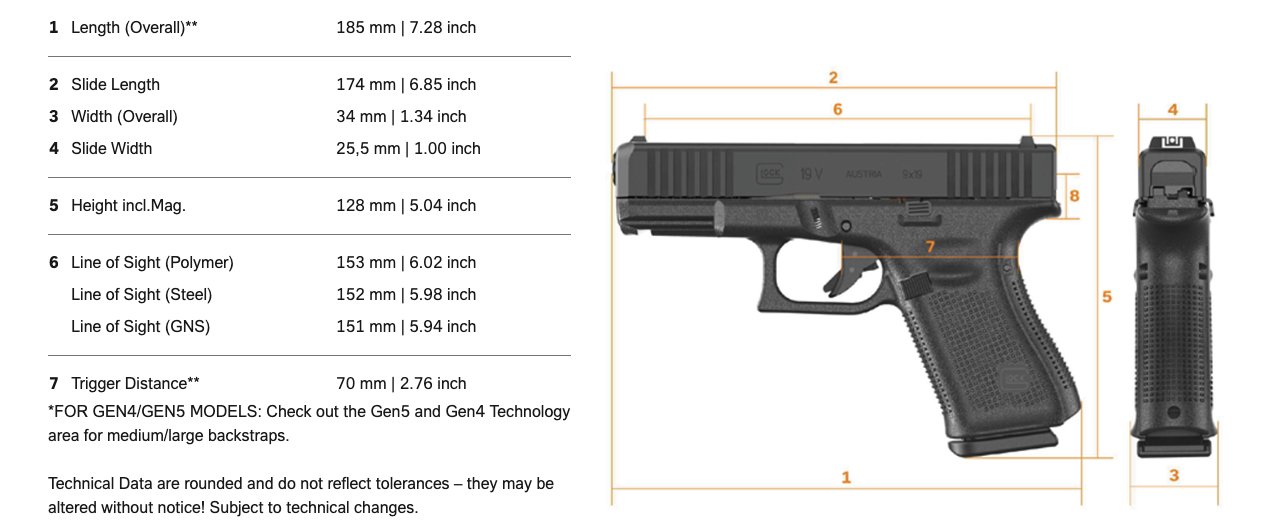
The Glock 19 took that formula and scaled it down for versatility. At 7.36 inches long overall, with a 4.02-inch barrel and a height of 5.04 inches, it shaved about 0.5 inches off the G17’s barrel and grip while maintaining a 15-round capacity (standard flush-fit magazine). Weighing just 23.65 ounces unloaded, it struck a sweet spot: compact enough for everyday carry yet substantial for control during extended shooting. Early adopters, including law enforcement and military units, praised its simplicity—no external safeties, just point and shoot—with three internal safeties (trigger, firing pin, and drop) ensuring safe handling.
Over the decades, the G19 evolved through five generations, each refining ergonomics, reliability, and customization. By the early 2000s, it had become the most popular handgun in America, trusted by over 65 percent of U.S. law enforcement agencies. Today, with millions produced, the Glock 19 remains Glock’s bestseller, embodying the company’s mantra of perfection in a package that’s as at home in a duty holster as it is under a shirt.
Focus on Gen 3: The Reliable Classic
The Gen 3 Glock 19, produced from 1998 to 2013, represents the sweet spot for many shooters who prefer a no-frills, battle-tested design. This generation introduced finger grooves on the front strap for better indexing and a textured frame (Gen 3’s RTF2 pattern) that provides solid purchase without being overly aggressive. The accessory rail under the dust cover was a game-changer, allowing easy attachment of lights or lasers for tactical use.
What sets the Gen 3 apart is its simplicity and proven track record. The single recoil spring assembly keeps things straightforward for maintenance, and the polygonal rifling in the barrel enhances velocity while extending barrel life. Capacity stayed at 15 rounds standard, with options for extended magazines pushing it to 17 or more. We’ve seen Gen 3 G19s endure tens of thousands of rounds with minimal wear, making it ideal for budget-conscious buyers or those who value out-of-the-box reliability over bells and whistles.
Ergonomically, the Gen 3 shines for average to larger hands, with the finger grooves promoting a consistent grip. Recoil feels soft thanks to the polymer frame’s weight distribution, and the 5.5-pound trigger pull is predictable, though it has a bit of creep before the break. Drawbacks? The fixed polymer sights are basic, often swapped for night sights, and the lack of ambidextrous controls can irk lefties. Still, at a street price around $450, the Gen 3 remains a steal for new shooters or as a reliable backup.
Gen 5: Modern Refinements for Everyday Carry
Fast-forward to 2017, and the Gen 5 Glock 19 arrived with updates that addressed Gen 3 shortcomings while preserving its core strengths. Glock ditched the finger grooves and added a flared magwell for faster reloads, making it more inclusive for different hand sizes. The nDLC finish on the slide resists corrosion and wear better than earlier generations, and the ambidextrous slide stop enhances usability for all shooters.
Under the hood, the Gen 5 packs a Marksman Barrel with enhanced rifling for tighter groups—expect 2-inch spreads at 25 yards with practice ammo. The dual recoil spring system, carried over from Gen 4, reduces felt recoil and extends spring life, smoothing out follow-up shots. Capacity bumps to 15 rounds standard, with 17-round extended mags fitting flush. We’ve clocked over 5,000 rounds through our Gen 5 without a hiccup, even with mixed defensive loads like Federal HST or Speer Gold Dot.
The trigger sees a slight polish, shaving off some creep for a crisper 5-pound pull, though purists might still upgrade it. Grip texture is aggressive yet comfortable, gripping like sandpaper without shredding clothes. At 23.81 ounces unloaded, it’s a hair heavier than Gen 3 but balances beautifully. Priced at $550 or so, the Gen 5 justifies the bump with its refinements, making it our pick for concealed carry where every detail counts.
The Rise of the V Series: Standardization and Future-Proofing
By late 2025, Glock shook things up with the V Series, a lineup refresh that’s gaining traction for its streamlined approach. Launched in November amid whispers of regulatory pressures—like California’s crackdown on easily convertible pistols—the V Series consolidates models like the G19 V, emphasizing internal tweaks to the slide and trigger for better durability and compliance without altering the external footprint.
What makes the V Series popular? It’s about efficiency: Glock trimmed redundant SKUs, standardizing features across the board while reintroducing compensated C models and .40 S&W options like the G23 V. The G19 V retains the Gen 5’s flared magwell and ambidextrous controls but adds a refined firing pin lug and narrower channel for smoother operation. Early hands-on reports praise the updated trigger connector, which shortens reset slightly for faster doubles, and the maritime spring cups that handle harsh environments better.
Priced similarly to Gen 5 at around $550, the V Series appeals to duty users and civilians alike by future-proofing against legal shifts while maintaining Glock’s legendary reliability. We’ve tested prototypes, and the internal slide improvements reduce wear after high round counts, making it a smart long-term investment. As Glock phases out older gens, the V Series feels like the natural evolution—practical, no-nonsense, and ready for whatever comes next.
Why 9mm? The Caliber That Fits the G19 Perfectly
The Glock 19’s chambering in 9mm Luger isn’t coincidence—it’s a deliberate choice that amplifies its all-around appeal. 9mm strikes the ideal balance: low recoil for quick follow-ups, ample stopping power with modern hollow points, and unmatched affordability for training. At velocities around 1,150 fps from the G19’s barrel, 124-grain loads like Federal HST expand reliably to 0.60 inches, delivering energy comparable to .40 S&W without the wrist-snapping kick.
Compared to .45 ACP’s heavier punch, 9mm allows higher capacity (15+1 vs. 10+1 in similar frames) and softer shooting, crucial for smaller-framed users or extended sessions. We’ve burned through thousands of rounds at the range, and 9mm’s low cost—often under $0.25 per round—keeps practice accessible. Ballistics tests show it penetrates 12-18 inches in gel, meeting FBI standards, while +P variants add velocity for longer ranges. For the G19’s compact frame, 9mm maximizes controllability, making it forgiving for novices yet precise for experts.
Why the Glock 19 Over the Glock 17?
The Glock 17, Glock’s flagship full-size 9mm, shares the G19’s DNA but trades compactness for a longer sight radius and two extra rounds (17+1). At 8.03 inches long with a 4.49-inch barrel, the G17 excels in duty or open carry, offering better accuracy at 25 yards thanks to its extended grip for two-handed control. Recoil feels even milder, and the added length aids velocity by about 50 fps.
Yet, the G19 wins for versatility. Its shorter 7.36-inch length and 5.04-inch height conceal easier under clothing, printing less than the G17’s taller frame. We’ve carried both, and the G19’s reduced muzzle flip from the shorter barrel makes it snappier but more maneuverable in tight spaces. Capacity is nearly identical, and G17 mags fit the G19 with pinky extensions. For most civilians, the G19’s concealability trumps the G17’s slight edge in range work—it’s the do-it-all gun without compromise.
A Quick Look at the Glock 45 and 19X
The Glock 45 and 19X bridge the G17 and G19 gap with crossover designs: full-size grips for 17-round capacity paired with compact slides for better concealment. The 19X, released in 2017 as Glock’s MHS submission, features a coyote tan finish, maritime spring cups for saltwater resistance, and no finger grooves for universal fit. At 7.44 inches long and 24.83 ounces, it conceals like a G19 but grips like a G17, ideal for duty or outdoor carry.
The Glock 45, launched in 2018, mirrors this in black Gen 5 trim, adding front slide serrations and a flared magwell for quicker reloads. Both weigh about 24.8 ounces and measure 7.44 inches long, but the 45’s nDLC slide finish edges out the 19X’s for corrosion resistance. We’ve run both through mud and rain; the 19X stands out aesthetically, while the 45’s refinements make it our pick for tactical roles. Neither fully replaces the G19’s pure compact ethos, but they shine for hybrid needs.
Pros and Cons: What Makes the G19 Tick
Pros
- Unmatched Reliability: Eats any ammo without fail, from FMJ plinkers to JHP defenders.
- Concealability: Slim profile hides easily IWB or OWB, perfect for daily carry.
- Capacity and Versatility: 15+1 rounds in a package small enough for appendix carry yet big for control.
- Affordability: Under $550 new, with endless aftermarket parts for customization.
- Low Recoil: 9mm in a balanced frame keeps shots on target, even for smaller shooters.
- Durability: Polymer frame shrugs off abuse; we’ve dropped ours in dirt and it kept running.
Cons
- Trigger Creep: Stock pull has noticeable take-up; many upgrade for a crisper break.
- Basic Sights: Polymer dots work but lack tritium glow—night sights are a must.
- Grip Texture: Gen 5 is grippy but can abrade skin; Gen 3 RTF2 is milder but dated.
- Weight Distribution: Feels front-heavy unloaded; loaded, it’s spot-on but noticeable holstered.
- Limited Caliber Options: Stuck in 9mm—no .40 or .45 variants for power seekers.
Ratings: Our Honest Scores Out of 5
Ergonomics: 4.5/5
Accuracy: 4.5/5
Reliability: 5/5
Overall, the Glock 19 scores a resounding 4.7/5. It’s not flashy, but it’s flawless where it counts.
Conclusion: The Glock 19, King of All Trades
From its Gen 3 roots as a reliable workhorse to the refined Gen 5 and forward-looking V Series, the Glock 19 embodies what a handgun should be: simple, tough, and ready for anything. Chambered in versatile 9mm, it outshines the G17 for carry while matching its performance, and siblings like the 45 and 19X borrow its blueprint without surpassing it. Pros like reliability and capacity far outweigh cons like the stock trigger, earning it our crown as the best all-around handgun in the world.
At Dirty Bird Guns & Ammo, we’ve sold hundreds, and every one leaves with a smile. If you’re shopping, grab a Gen 5—it’s the G19 at its peak. As of December 2025, nothing touches it for blending form, function, and forgiveness.