

 Dirty Bird Bakersfield
Pistols
The Springfield Echelon in 2025: A Hands-On Take on a Duty-Grade Striker

Feb
Table of Contents
It’s February 2025, and I’ve been beating on the Springfield Echelon for weeks—range sessions, holster time, late-night tinkering under a shop light. At Dirty Bird Guns & Ammo, we’ve had this pistol in rotation since it landed, and it’s still one of the sharpest tools we’ve handled. The Springfield Echelon isn’t your run-of-the-mill striker-fired 9mm; it’s a modular workhorse that pairs rugged engineering with a trigger that’ll make you ditch your Glock without a backward glance. I’ve pushed over 1,200 rounds through it, carried it daily, and swapped its parts like a gearhead. Here’s what it’s like to live with the Springfield Echelon in 2025.
Springfield’s got a knack for taking proven ideas and cranking them up a notch. The Echelon’s their swing at a duty-grade striker—think Sig P320 meets XD-M Elite, but with a twist. Launched a couple years back, it’s built around a chassis system that lets you swap grips like outfits, a trigger that snaps like a dream, and a capacity that keeps you in the fight. I’ve shot it hard, carried it harder, and it’s still begging for more. Let’s unpack what makes this thing tick.
A Striker Built Different
At first, I was hesitant to trust a Springfield for daily carry. I’ve heard way to many horror stories about the XD and its failures at classes. That said, the Springfield Echelon is coming from somewhere entirely different, and I wanted to give it a fair shot.
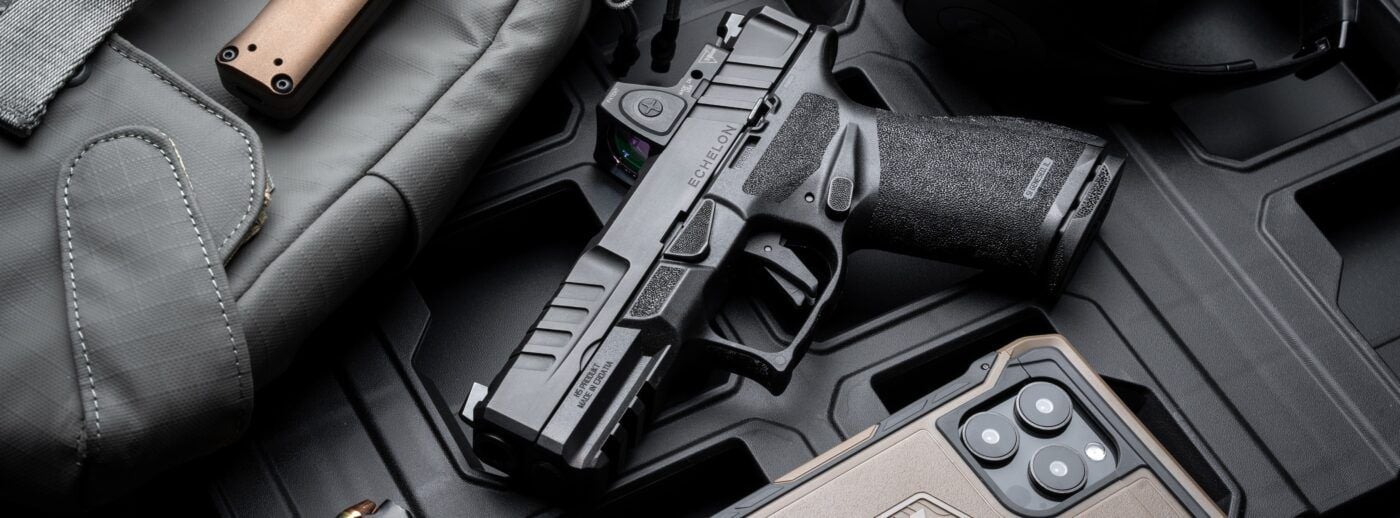
The Springfield Echelon’s heart is its Central Operating Group (COG), a serialized stainless steel chassis that’s the legal “gun,” not the polymer shell around it. That means you can pop it out and slap it into a new grip module without an FFL trip. Out of the box, it’s a full-size 9mm with a 4.5-inch barrel, shipping with two mags: 17 rounds flush, 20 rounds extended. I’ve got both, and the 20-rounder’s my go-to; it balances the heft without turning it into a brick. The frame comes in three sizes: small, medium, large…and I’ve settled on the medium after fiddling with all three. It’s got just enough meat to fill my hand without feeling like I’m gripping a 2×4.
What hits you first about the Springfield Echalon is the build. At 33 ounces unloaded, it’s got substance…enough to steady your aim but not so much it drags you down after a long day. The slide’s Melonite-coated steel, with serrations front and back that lock into your palm like they mean it. I’ve racked it in rain, sweat, and dust, and it’s never slipped. The black polymer grip’s got aggressive texturing that clings without shredding your shirt…Springfield calls it “adaptive,” and it’s no marketing fluff. This thing’s made to work, not just to look pretty.

Range Time with the Springfield Echelon: Where It Shines
First outing, I loaded those 17-round mags with Federal 115-grain FMJ and let it loose. The trigger’s the knockout punch—smooth take-up, a crisp wall, and a break at about 4 pounds that feels like glass snapping. Reset’s short, sharp, and audible; I’m back on target before the casing pings the ground. I’ve shot plenty of strikers—Glocks, Sigs, you name it—and this one’s in a league of its own. At 20 yards, I’m stacking 2-inch groups with the U-Dot tritium sights; mount a Holosun 507 via the Variable Interface System (VIS).

The VIS is a game-changer. No clunky plates—just adjustable pins that lock over 30 optics in place. I’ve swapped between that Holosun, a Trijicon RMR, and a Leupold DeltaPoint, and it’s held zero every time. The optic sits low, co-witnessing with the front sight, which I’ve leaned on for low-light drills. Recoil’s a non-issue—the hammer-forged barrel and that 33-ounce frame eat it up. I’ve pushed Speer Gold Dot 124-grain +P through it, and follow-ups are lightning; muzzle rise is there, but it’s polite. Break-in took maybe 150 rounds—one failure to eject early on with the 20-round mag—but since then, it’s been a freight train.
I’ve seen shooters on X rave about it. One guy called it “the striker Sig wishes it made,” while another said “17 rounds and that trigger? Yes please.” A few grumbled about early hiccups, but mine’s been smooth sailing post-break-in. Feed it, and it fires.
Build: Crafted for the Long Haul
The Echelon’s no lightweight—it’s built to take a beating. That Melonite finish on the slide’s held up through holster wear, range dirt, and a couple drops on concrete; barely a nick. The Picatinny rail under the dust cover’s got a Streamlight TLR-7 bolted on, turning night shoots into a breeze. Ambi controls are standard—slide stop and mag release on both sides—and they’re chunky enough to hit without hunting. My hands aren’t huge, and I’ve never fumbled.
The COG’s the ace up its sleeve. Pop it out—no tools, no trigger pull—and you’re holding a polished steel core: trigger group, rails, all machined tight. I’ve swapped it between the medium and large grips just to feel the difference; it’s like getting a new gun without the paperwork. The grip modules are black polymer—nothing flashy—but the texturing’s spot-on. I’ve heard guys online say the large grip’s too blocky, but I’d argue it’s perfect for bigger mitts or gloved hands. This isn’t a fashion piece; it’s a tool.

Living With the Springfield Echelon: Carry and Maintenance
Carrying the Echelon’s a trade-off. That 4.5-inch barrel and 1.3-inch width make it a full-size duty gun—not a subcompact by any stretch. I’ve run it in a Vedder LightTuck IWB under a jacket; it conceals fine in cooler months, but summer’s a chore unless you’re in loose gear. At 33 ounces, it’s noticeable after a few hours, but the balance keeps it from feeling like a boat anchor. The 17-round mag sits flush, and the 20 sticks out a bit—neither screams “gun” under a flannel, but it’s no pocket pistol.
Maintenance is striker-simple with a twist. Field strip’s a snap—lock the slide, flip the lever, done. Deep cleaning’s fussier; the COG’s tight fit catches grit, and the rails need a good scrub. I’ve been using Slip2000, and it’s back to new in 15 minutes. Reliability’s been ironclad after that early hiccup—I’ve fed it Blazer, Winchester White Box, Hornady Critical Duty, and my carry load, Speer Gold Dot 124+P, and it’s never blinked. Keep it lubed, and it’ll run all day.
How It Stacks Up
Against a Glock 17, the Springfield Echelon’s smoother, heavier, and more refined. The trigger’s a clear win, and the VIS optics setup smokes Glock’s MOS. Compared to an XD-M Elite, it’s more modular—swap grips, not frames—and feels a step up in fitment. A Sig P320 XFull’s its closest rival; the Sig’s got similar chassis vibes, but the Echelon’s trigger and ergo edge it out for me, and it’s cheaper out the door. Online, one shooter dubbed it “a duty gun with soul,” while another said “it’s what the Glock 17 should’ve been.” I’d argue it’s carving its own path—less evolution, more reinvention.
Real-World Use: Range to Reality
The Springfield Echelon is a range beast, but it’s more than that. I’ve carried it daily for weeks—17 rounds of 9mm Critical Duty in the pipe—and it’s a confidence booster. The weight steadies your hand; I’ve ripped off 10-shot strings at 15 yards and stayed on steel every time. Competition shooters on forums love the 5-inch version (I’ve got the 4.5), calling it “stable as hell” with a hair more velocity. Home defense? Slap that TLR-7 on, and 17+1 is plenty to handle a bad night. Carry’s trickier—it’s no CCW champ—but with the right rig, it works.
Why the Springfield Echelon Contender in 2025
After weeks with the Springfield Echelon, I get why it’s still kicking in 2025. It’s not flawless—early break-in’s a grind, and it’s no featherweight—but it’s a striker that delivers. That COG keeps it versatile; I could see Springfield dropping a compact grip down the line. The trigger’s a class-leader, the VIS optics are future-proof, and at $600-$650 street price, it’s a hell of a deal. At Dirty Bird Guns & Ammo, we’ve watched shooters pick it up and not put it down. It’s a duty gun with guts—shoot it yourself and see what I mean.