

 Dirty Bird Bakersfield
AR Parts and Accesories, AR-15, AR-15 Barrels, AR-15 Complete Uppers, AR-15 Upper Receiver, Upper Receivers
Gun Parts and Components Explained: A Beginner’s Guide to the AR-15
Jan
Table of Contents
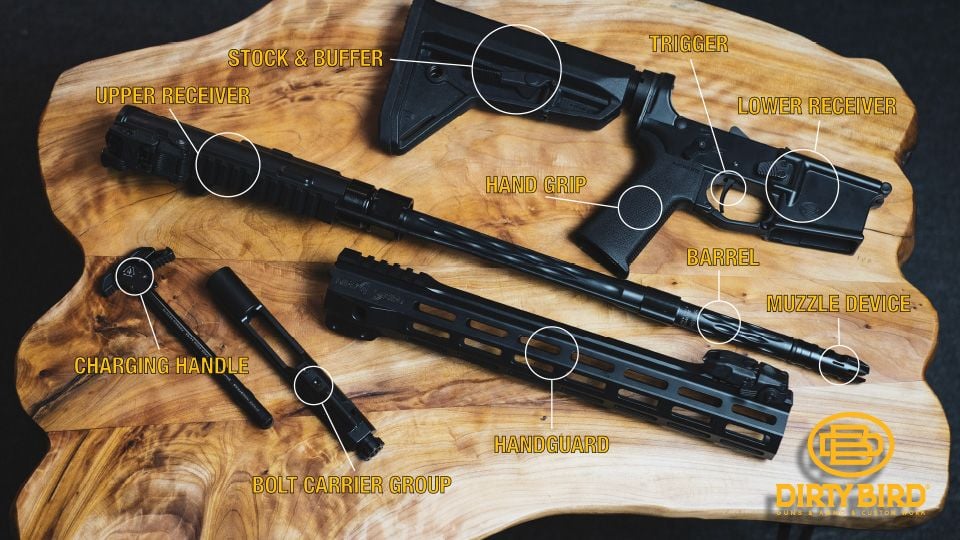
The AR-15 platform is one of the most popular and customizable rifles available. Its modular design allows owners to build, maintain, or upgrade the firearm with relative ease. For beginners at Dirty Bird Guns & Ammo, understanding the main gun parts is the first step toward safe ownership, reliable performance, and smart purchasing decisions. This guide explains the essential gun parts, highlights the difference between a stripped upper receiver and a complete upper receiver, and covers common questions new shooters have when shopping for gun parts, gun parts kits, or accessories.
Understanding the AR-15 Platform
The AR-15’s popularity stems from its versatility and straightforward design. Unlike many traditional rifles that require specialized tools and gunsmithing knowledge to modify, the AR-15 can be customized by the average owner with basic hand tools. This modularity means you can start with a basic configuration and gradually upgrade individual gun parts as your skills and needs evolve. The rifle separates into two main sections – the upper receiver assembly and the lower receiver assembly – which connect with two captive pins that require no tools to operate. This simple takedown design makes cleaning, maintenance, and parts swapping remarkably straightforward.
The AR-15’s widespread adoption by military, law enforcement, competitive shooters, and civilians has created a massive aftermarket for parts and accessories. This means you have virtually unlimited options when selecting components, from budget-friendly mil-spec parts to premium upgrades designed for specific applications. Understanding how these parts work together helps you make informed decisions that match your intended use, whether that’s home defense, target shooting, competition, or hunting.
Upper Receiver vs Complete Upper Receiver
The upper receiver is the aluminum housing that forms the top half of the rifle. It contains the forward assist, ejection port cover, and the threaded area where the barrel attaches. A stripped upper receiver is simply this bare housing without any additional components installed.
A complete upper receiver is a fully assembled unit that includes the stripped upper receiver plus the barrel, bolt carrier group, charging handle, gas system, handguard, forward assist, ejection port cover, and often a muzzle device. Because all gun parts are pre-installed and headspaced at the factory, a complete upper is ready to pin onto a lower receiver and function immediately. This format eliminates the need for separate barrel installation, gas tube alignment, or torque specifications during assembly, making it the preferred choice for beginners or anyone who wants a proven, ready-to-run upper half.
For new builders, the complete upper receiver offers several distinct advantages. First, it eliminates headspacing concerns – the critical measurement between the bolt face and the chamber that must be correct for safe operation. Second, it removes the need for specialized tools like barrel wrenches, torque wrenches, and receiver blocks that can cost hundreds of dollars. Third, it ensures that all components are properly matched and tested together, reducing the risk of compatibility issues or assembly errors that could affect reliability or safety.
Experienced builders sometimes prefer stripped uppers because they allow complete control over all gun parts and can be more economical when you already own the necessary tools. However, the time savings and guaranteed compatibility of a complete upper make it the smart choice for most shooters, especially those building their first AR-15.
Gun Parts Explained – Lower Receiver
The lower receiver is the serialized part legally classified as the firearm. It houses the trigger group, fire control components, magazine well, pistol grip, and buffer tube. The trigger group releases the hammer to strike the firing pin and fire the round. The buffer system (buffer tube, buffer, and spring) manages recoil energy and returns the bolt carrier group forward after each cycle. The stock attaches to the buffer tube and provides a comfortable shoulder rest. Because the lower receiver is the regulated component, it requires a background check and transfer through a licensed dealer when purchased.
The lower receiver is typically forged or machined from 7075-T6 aluminum alloy, chosen for its excellent strength-to-weight ratio and corrosion resistance. Quality gun parts like this feature properly dimensioned trigger and hammer pin holes, smooth magazine wells with flared openings for easier reloads, and correct threading for the pistol grip and buffer tube. Some manufacturers offer enhanced lowers with features like integrated trigger guards, flared magazine wells, or tension screws that eliminate play between the upper and lower receivers.
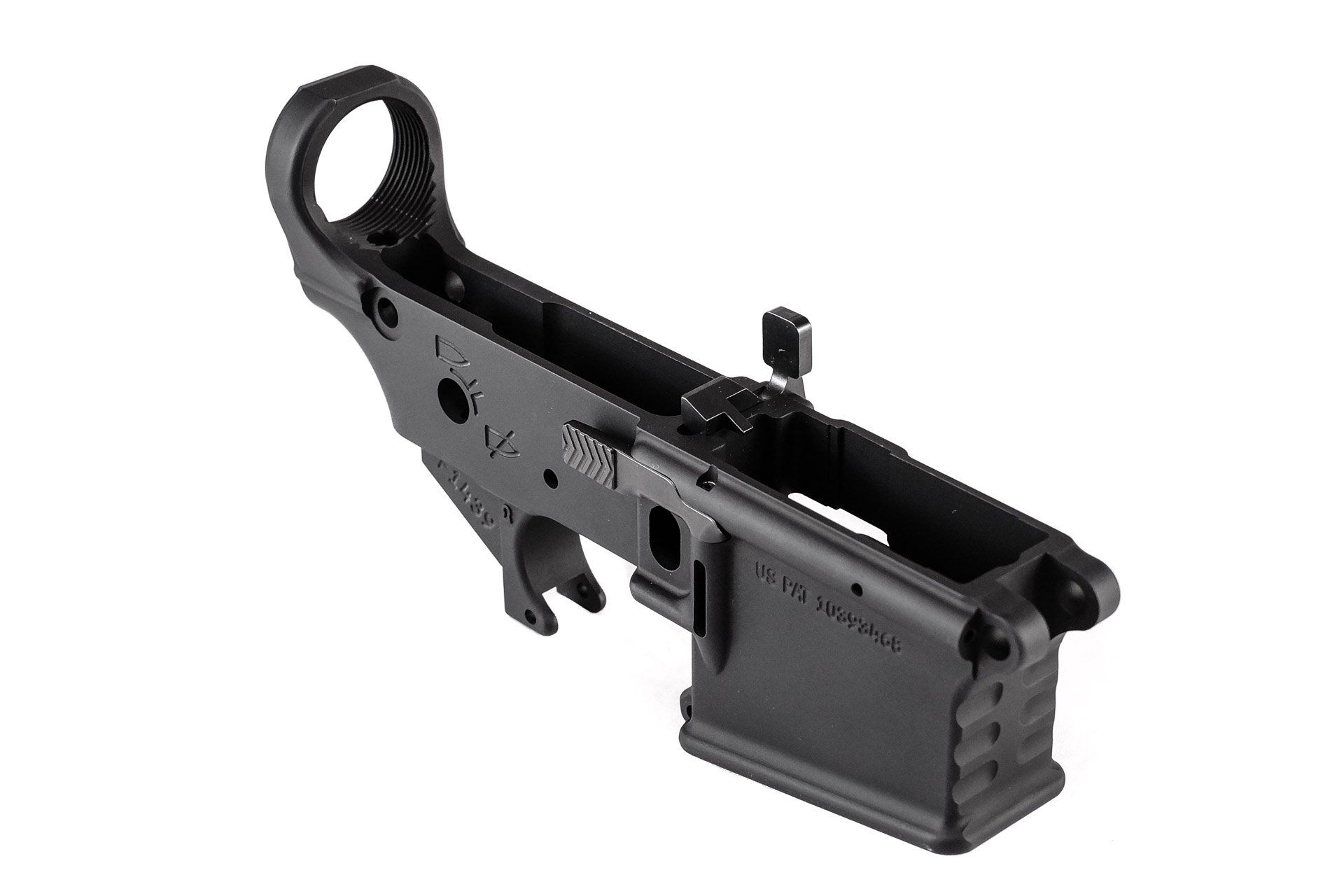
The lower receiver’s role as the legal firearm means it’s the only component that requires the same purchase process as a complete gun. All other parts – uppers, barrels, triggers, stocks, and accessories – can typically be purchased without restrictions and shipped directly to your home. This makes the AR-15 platform particularly accessible for those who want to build gradually, purchasing a lower receiver through proper channels and then acquiring other components as budget allows.
Gun Parts Explained – Trigger Group
The trigger group controls when the hammer falls to initiate the firing sequence. It includes the trigger, hammer, disconnector, and related springs. A smooth, consistent trigger pull improves accuracy and control. Factory triggers are reliable for most users, but many owners later upgrade to lighter or crisper aftermarket triggers once they have experience with the rifle in stock form.
Standard mil-spec triggers typically have a pull weight between 5.5 and 7 pounds with some creep and grittiness. While perfectly functional and safe, they’re designed for military durability rather than precision shooting. The disconnector ensures the rifle fires only one round per trigger pull in semi-automatic mode, making it a critical safety component. The trigger and hammer pins hold these parts in place and must be properly sized to prevent excessive wear or dangerous malfunctions.
Many shooters eventually upgrade to aftermarket triggers that offer lighter pull weights (typically 3 to 4.5 pounds), reduced creep, cleaner breaks, and shorter reset distances. Single-stage triggers break at a consistent weight throughout the pull, while two-stage triggers have an initial take-up followed by a lighter, crisper final break. These upgrades can significantly improve accuracy, especially for precision shooting or competition, but should only be installed after you’re thoroughly familiar with your rifle’s baseline performance.
Barrel
The barrel is the long metal tube that the bullet travels through. It determines the rifle’s accuracy, muzzle velocity, and effective range. Barrels are typically made from chrome-moly vanadium steel with protective finishes such as nitride or chrome lining to resist corrosion and extend service life. The barrel is one of the two most critical components in the rifle. A high-quality barrel delivers consistent performance and longevity, while a poor barrel can reduce accuracy and reliability.
Barrel length significantly impacts performance characteristics. Common lengths range from 7.5 inches for pistol configurations to 20 inches for precision and long-range applications. The most popular length is 16 inches, which represents the minimum legal rifle length and offers an excellent balance of velocity, accuracy, and maneuverability. Longer barrels increase bullet velocity and improve accuracy at distance but reduce handling speed. Shorter barrels enhance maneuverability but sacrifice velocity and may produce increased muzzle blast and flash.
The barrel profile describes its external contour and affects weight distribution, heat management, and rigidity. Government profile barrels are heavier under the handguard and lighter at the muzzle, following the M4 carbine specification. Heavy barrels maintain accuracy during extended firing sessions but add weight. Lightweight or pencil barrels reduce overall rifle weight but heat up faster during rapid fire. The barrel extension at the rear contains the locking lugs that the bolt engages and must be properly aligned with the upper receiver for reliable function.
Barrel twist rate, expressed as a ratio like 1:7 or 1:9, determines how quickly the rifling spins the bullet. Faster twist rates (smaller numbers) stabilize heavier bullets better, while slower twist rates work well with lighter projectiles. Modern 5.56 NATO barrels commonly use 1:7 or 1:8 twist rates for versatility across the full range of bullet weights.
Gun Parts Explained – Handguard
The handguard surrounds the barrel to protect the shooter’s support hand from heat and provides mounting points for accessories such as lights, grips, or bipods. Modern handguards are usually free-floating, meaning they attach only to the upper receiver and do not contact the barrel. This design prevents external pressure from flexing the barrel, which improves accuracy compared to traditional handguards.
Free-floating handguards attach via a barrel nut that threads onto the upper receiver, with the handguard extending forward without touching the barrel or gas block. This isolation prevents pressure from your support hand, a sling, or a bipod from affecting barrel harmonics and shifting point of impact. The improvement in accuracy can be dramatic, especially at longer ranges where small deflections translate into significant point-of-impact shifts.
Most modern handguards use M-LOK or KeyMod attachment systems, which provide slim profiles with mounting slots cut into the handguard at various positions. These systems allow you to attach accessories exactly where needed without the weight and bulk of continuous Picatinny rails. Many handguards retain a short Picatinny rail section on top for mounting optics while using M-LOK on the sides and bottom for lights, grips, and other accessories.
Handguard length should be chosen based on your barrel length and accessory needs. A handguard that extends most of the way to the muzzle device provides maximum mounting space and hand positions but adds weight. Shorter handguards reduce weight and allow easier access to traditional muzzle devices but limit where you can position accessories and your support hand.
Bolt Carrier Group
The bolt carrier group (BCG) is the moving assembly inside the upper receiver that loads a round, fires it, extracts the spent case, and chambers the next round. It cycles thousands of times under high heat and pressure, making it the other heart of the rifle alongside the barrel. A quality BCG features a full-auto-rated carrier, shot-peened bolt, magnetic particle inspected components, and protective coatings such as nitride or nickel boron for easier cleaning and longer life.
The BCG consists of several components working together: the carrier, bolt, firing pin, cam pin, gas key, and extractor with spring. The carrier is the large cylindrical housing that travels back and forth inside the upper receiver. The bolt locks into the barrel extension to contain the pressure when firing. The firing pin strikes the primer to ignite the powder. The cam pin controls the bolt’s rotation during locking and unlocking. The gas key channels expanding gases from the gas tube to drive the carrier rearward. The extractor grabs the rim of the spent case and pulls it from the chamber.
Full-auto-rated carriers have additional material at the bottom rear where an auto-sear would engage in select-fire rifles. While this doesn’t make them heavier than semi-auto carriers, the full-auto profile is considered more robust and is the standard for quality AR-15 builds even in semi-automatic applications. Shot-peening the bolt involves bombarding it with small spherical media under controlled conditions, which work-hardens the surface and relieves internal stresses that could lead to cracks. Magnetic particle inspection (MPI) uses magnetic fields and iron particles to detect microscopic cracks or flaws that could cause catastrophic failure.
Proper staking of the gas key screws is essential – the metal around the screw heads should be deformed into the slots to prevent the screws from backing out during use. A gas key that comes loose will cause immediate and severe reliability problems. Quality BCGs also feature properly tensioned extractor springs and well-fitted gas rings that seal against the carrier to maintain pressure.
Stock and Buffer System
The stock provides a comfortable place to shoulder the rifle and helps control recoil. It attaches to the buffer tube, which houses the buffer and spring. The buffer system absorbs recoil energy and ensures the bolt carrier group returns forward reliably after each cycle. A properly tuned buffer system prevents excessive bolt speed or short-stroking, contributing to smooth operation and reduced wear on other parts.
Buffer tubes come in two main types: carbine-length and rifle-length. Carbine tubes are shorter and typically paired with adjustable stocks that allow length-of-pull customization for different shooters or shooting positions. Rifle-length tubes are longer and usually have fixed stocks. The buffer and spring inside must match the tube length and gas system for reliable operation.
The buffer itself is a weighted cylinder that absorbs the rearward energy of the bolt carrier group. Standard carbine buffers weigh about 3 ounces, while H (heavy) buffers weigh approximately 3.8 ounces for smoother operation or use with certain ammunition types. H2 buffers weigh around 4.6 ounces and H3 buffers around 5.0 ounces, with progressively heavier options used for specific applications like suppressed shooting or overgassed systems. The buffer spring provides the tension to return the BCG forward after cycling.
Stock options range from basic fixed A2 stocks to modern adjustable designs with multiple length-of-pull positions, cheek risers, and storage compartments. Choosing a stock is largely about personal preference and ergonomics, though some competitive shooters or precision applications may benefit from specific designs that enhance stability or adjustability.
Gun Parts Explained – Gas System
The gas system is what makes the AR-15 a semi-automatic rifle. A small port drilled in the barrel allows expanding gases to escape through a gas tube back to the bolt carrier group, driving it rearward to cycle the action. The gas system length – the distance between the chamber and gas port – must match the barrel length for reliable operation.
Pistol-length gas systems are used on barrels under 10 inches. Carbine-length systems work with 10 to 18-inch barrels but are most common on 14.5 to 16-inch configurations. Mid-length systems are increasingly popular on 14.5 to 18-inch barrels, offering softer recoil and reduced port pressure compared to carbine systems. Rifle-length systems appear on 18 to 20-inch barrels and provide the smoothest operation with the least stress on components.
The gas block clamps or pins to the barrel at the gas port and redirects gas into the gas tube. Low-profile gas blocks fit under modern handguards, while older A2 front sight bases incorporate the gas block into a tower-mounted front sight. Adjustable gas blocks allow you to fine-tune gas flow for different ammunition or when adding a suppressor, which significantly increases back pressure.
Gun Parts Explained – Charging Handle
The charging handle is the T-shaped lever at the rear of the upper receiver that you pull back to chamber the first round or clear malfunctions. Standard mil-spec charging handles work fine for most applications, but many shooters upgrade these gun parts to be ambidextrous or extended-latch versions that are easier to operate, especially when using optics with large eye boxes or when shooting from unconventional positions.
Muzzle Device
Muzzle devices are gun parts that are mounted on the front of the barrel and serve various purposes. Flash hiders reduce visible muzzle flash to preserve the shooter’s night vision and conceal position. Muzzle brakes redirect gases to counteract recoil and muzzle rise, improving follow-up shot speed. Compensators specifically address muzzle rise. Some devices combine functions. Many shooters use muzzle devices with quick-detach mounts for suppressors, allowing rapid attachment and removal of a sound suppressor.
Gun Parts vs Accessories
Gun parts are the essential components required for the rifle to function safely and legally. These include the barrel, bolt carrier group, trigger group, receivers, and buffer system. Replacing or upgrading these parts changes how the rifle operates.
Firearm accessories are add-on items that enhance usability but are not required for basic function. Examples include optics, slings, lights, vertical grips, and bipods. Accessories improve the shooting experience without altering the core mechanism of the rifle.
Understanding this distinction helps when planning builds or upgrades. Investing in quality parts ensures reliability and safety, while accessories can be selected based on specific needs and budget. Most experienced shooters recommend getting the core parts right first, then adding accessories as you identify specific needs through actual use of the rifle.
Critical Gun Parts for Safe Operation
Certain components are vital for safe and reliable use. The trigger group must prevent accidental discharge. The bolt carrier group needs to lock and unlock correctly to contain chamber pressure. The barrel must withstand firing stresses. The safety selector should block the trigger when set to safe. The buffer system controls recoil and prevents damage from excessive bolt speed. Faulty or worn parts in these areas can create unsafe conditions, so regular inspection is essential.
The extractor must reliably grab spent cases for extraction. The ejector must kick cases clear of the ejection port. Gas rings must seal properly to maintain cycling pressure. The firing pin retaining pin must stay in place to prevent the firing pin from traveling too far forward. Each of these components plays a specific role in the firing cycle, and failure of any one can cause malfunctions ranging from annoying to dangerous.
Interchangeability and Compatibility
Many AR-15 parts follow mil-spec standards, making them interchangeable across manufacturers. Upper receivers generally mate with any mil-spec lower receiver, and handguards, charging handles, and buffer tubes are broadly compatible. However, some parts are specific to certain models or configurations. Bolt carrier groups must match the bolt face to the cartridge. Barrels are tied to gas system lengths and receiver threading. AR-15 and AR-10 parts are not interchangeable due to size and design differences. Always verify compatibility before purchasing gun parts or gun parts kits to avoid fitment issues.
Some manufacturers use proprietary dimensions or features that limit interchangeability. For example, some billet receivers have non-standard trigger pin spacing, requiring specific triggers. Some handguards use proprietary barrel nuts that won’t work with other brands. When building or upgrading, stick with mil-spec dimensions unless you’re certain about compatibility with proprietary parts.
The term “mil-spec” refers to parts manufactured to military specifications, ensuring dimensional consistency and material quality. While mil-spec parts are generally interchangeable, quality can still vary between manufacturers. Some companies exceed mil-spec standards while others barely meet them, so reputation and reviews matter when selecting parts.
Regulated Components
The lower receiver is the only part classified as a firearm under federal law and requires a background check and transfer through a licensed dealer. Upper receivers, barrels, bolt carrier groups, triggers, handguards, stocks, and most other gun parts can be purchased online and shipped directly to consumers without an FFL transfer. Complete gun parts kits that exclude a regulated lower receiver are also unrestricted.
This regulatory framework makes building an AR-15 straightforward from a legal perspective. You complete the background check once for the lower receiver, then all other components can be purchased like any other consumer product. This also means you can buy multiple uppers in different calibers or configurations and swap them on a single lower receiver, essentially having multiple rifles for the cost of one serialized part plus uppers.
Parts That Wear Out First
The bolt carrier group, particularly the bolt and firing pin, experiences the most mechanical stress and typically wears out first. Extractor springs, gas rings, and buffer springs lose tension over time. Barrels gradually lose accuracy after high round counts due to throat erosion. Regular cleaning and inspection help identify worn parts early so they can be replaced before they affect reliability.
Extractor springs should be replaced every few thousand rounds or whenever extraction becomes inconsistent. Gas rings should be checked regularly by standing the bolt carrier upright – if it falls under its own weight, the rings need replacement. The firing pin should move freely in the bolt without binding. Buffer springs should be replaced when they show signs of compression or if the rifle starts short-stroking.
Barrels are consumable items with finite accuracy life. A quality chrome-lined barrel might deliver acceptable accuracy for 15,000 to 20,000 rounds, while a match-grade stainless barrel might show degradation after 5,000 to 10,000 rounds depending on use and maintenance. Accuracy degradation is gradual, so most shooters won’t notice until groups open significantly. For defensive rifles, reliability matters more than match-grade accuracy, so barrels can serve much longer than precision applications would allow.
Upgrading for Beginners
Beginners should start with factory or high-quality mil-spec components to learn how the rifle performs in its stock configuration. Factory parts are designed to work together reliably and help identify any baseline issues. Upgrading too early can introduce compatibility problems or mask underlying faults. Once you gain experience, targeted upgrades such as a better trigger or handguard make sense. Always choose quality gun parts from reputable sources.
The most impactful first upgrade for most shooters is the trigger, which directly affects accuracy and shooting enjoyment. A quality trigger can transform the shooting experience without affecting reliability when properly installed. Optics are another high-value upgrade, allowing faster target acquisition and better precision than iron sights for most applications.
Avoid upgrading parts that don’t address specific problems or needs. Replacing a functional barrel just for slightly different specs rarely provides noticeable benefit. Similarly, expensive bolt carrier groups offer minimal improvement over quality mil-spec units for most shooters. Focus upgrades on components that directly improve your shooting experience or address identified weaknesses.
Where to Find High-Quality Gun Parts Online
Trusted online retailers specializing in AR-15 components offer detailed descriptions, compatibility information, and customer support. Dirty Bird Guns & Ammo provides wholesale prices on AR-15 parts, complete uppers, gun parts kits, and accessories, with a focus on reliable products and helpful guidance for every skill level.
When shopping online, look for retailers that provide detailed specifications, compatibility notes, and responsive customer service. Quality retailers stand behind their products with clear return policies and will help resolve any issues. Reading customer reviews helps identify both excellent products and potential problems before purchasing.
Building knowledge about parts and components transforms you from a passive consumer into an informed owner capable of maintaining, troubleshooting, and customizing your rifle. Start with the basics, ask questions, and gradually expand your understanding through hands-on experience.
Mastering these basic gun parts gives new shooters confidence to maintain, upgrade, or build an AR-15 safely. Start with quality components, inspect them regularly, and upgrade thoughtfully as your experience grows. At Dirty Bird Guns & Ammo, we stock everything you need to get started or refine your rifle, with the expertise to help you make informed decisions at every step of your AR-15 journey.