

 Dirty Bird Bakersfield
Glock
Glock Parts Diagram: Understanding Your Pistol Inside and Out
Dec
Table of Contents
At Dirty Bird Guns & Ammo, we have been fielding a ton of questions about Glock pistols lately. With the recent rollout of the V Series models, designed to streamline production with internal updates for enhanced compatibility and performance, and the announcement of the all-new Generation 6 pistols on December 6, 2025, interest is at an all-time high.
The Glock Gen 6 introduces significant ergonomic improvements, including palm swells for better hand fit, aggressive RTF6 grip texturing, flat-faced triggers, undercut trigger guards, extended beavertails, and a refined optics-ready system. Initial models like the G17 Gen6, G19 Gen6, and G45 Gen6 are set to hit shelves in January 2026, promising better control and comfort right out of the box.
All this innovation has new buyers, longtime owners, and custom builders asking the same core question: what makes a Glock a Glock, and how do all the parts work together?
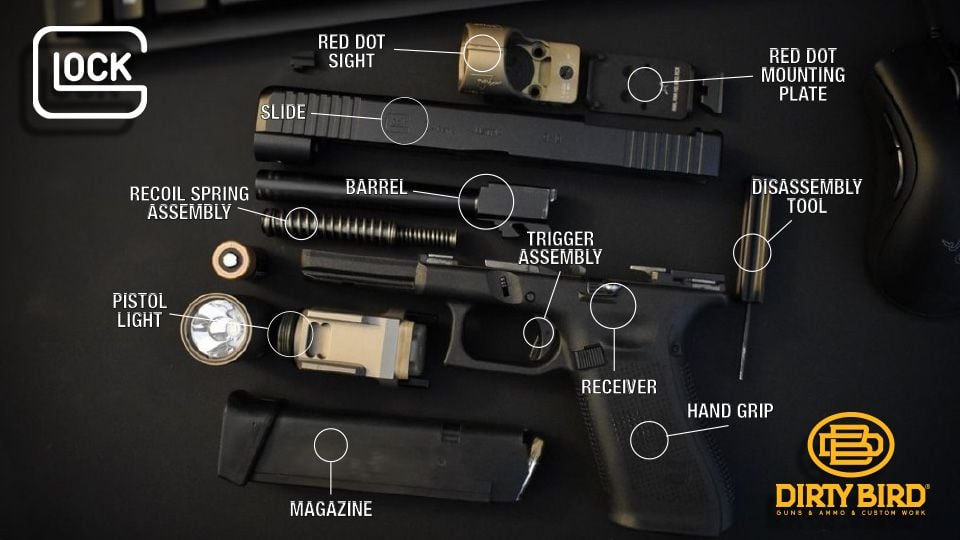
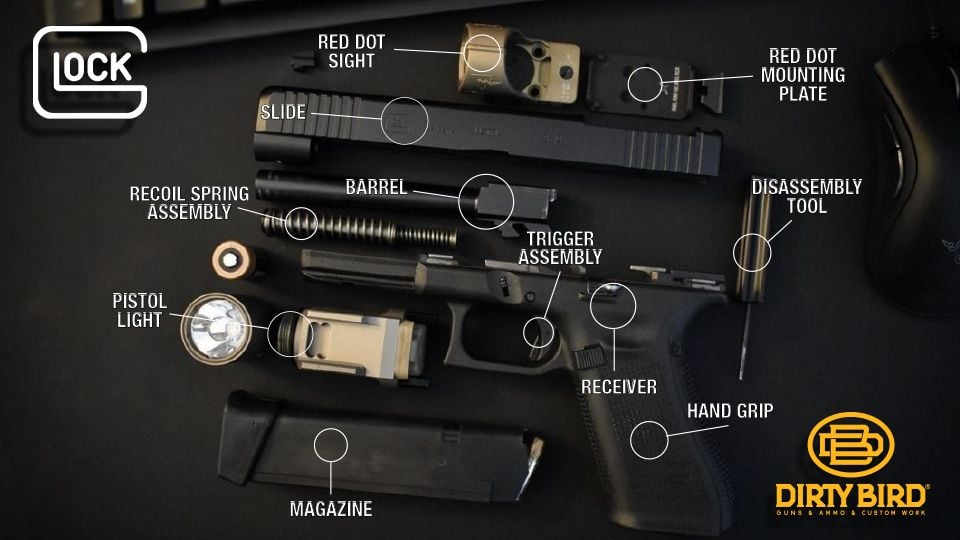
That is why we created this comprehensive guide featuring a custom parts diagram based on the detailed photo breakdown shown here. The image displays a field-stripped Glock with popular upgrades, offering a clear visual reference for key components and common accessories. Whether you are maintaining a Gen 5, exploring V Series changes, or preparing for Gen 6, understanding these parts helps explain the platform’s long-standing reputation for reliability.
The Secret to “Perfection”
Glock pistols have dominated the handgun market for decades by prioritizing simplicity, durability, and function. Introduced in 1982 by Gaston Glock, the original polymer-framed, striker-fired design was revolutionary.
A standard Glock contains roughly 34 to 35 parts, far fewer than many traditional handguns. Fewer parts mean fewer failure points. The polymer frame is lightweight, corrosion-resistant, and extremely durable, capable of handling drops, temperature extremes, and harsh environments without cracking or rusting.
Steel components like the slide and barrel are treated with a Tenifer or modern nitriding finish, providing exceptional wear and corrosion resistance. Glock’s striker-fired Safe Action system uses three internal safeties—a trigger safety, firing pin safety, and drop safety—to ensure the pistol only fires when the trigger is deliberately pulled. There is no external manual safety to manipulate under stress.
Glocks are known for running thousands of rounds with minimal cleaning, even in mud, sand, or water. Generous tolerances allow reliable cycling with a wide range of ammunition. This track record explains their widespread adoption by military units, law enforcement agencies, competitive shooters, and civilian carriers.
Affordability, massive aftermarket support, and ease of customization further strengthen the platform. As shown in the diagram, accessories like red dot optics and weapon lights integrate seamlessly. The V Series refines internal compatibility, while Gen 6 builds on the formula with improved ergonomics. Simply put, a Glock works consistently, safely, and effectively.
Breaking Down the Glock Parts Diagram
Below is a breakdown of each major component shown.
Slide
The slide is the large upper assembly at the top of the image. Machined from steel and finished with a black nitride or similar coating, it houses the barrel, recoil system, and firing components. Front and rear serrations improve grip for racking under stress or with gloves.
During firing, the slide cycles rearward to extract and eject the spent casing, then returns forward to chamber a new round. Optics-ready slides feature cuts or mounting plates for red dot sights.
Barrel
Positioned beneath the slide is the barrel, a hammer-forged steel component with polygonal rifling. This design improves accuracy, increases velocity, and simplifies cleaning. Glock Marksman Barrels, standard from Gen 5 onward, feature enhanced rifling for better precision. Glock barrels are built to handle high round counts and +P ammunition reliably.
Recoil Spring Assembly
Located alongside the barrel is the recoil spring assembly. This captive spring system absorbs recoil energy and drives the slide forward after cycling. While earlier generations used dual springs in many models, Gen 6 9mm pistols return to a single captive spring for simplicity without sacrificing control. It is a wear item but known for long service life.
Trigger Assembly
The trigger assembly includes the trigger shoe, trigger bar, connector, and trigger housing. It forms the heart of Glock’s Safe Action system. The polymer trigger features an integrated safety lever that must be depressed to fire. Standard pull weight is around 5.5 pounds. Gen 6 models introduce a flat-faced trigger shoe for improved leverage and feel. Aftermarket connectors are commonly used to tune pull weight for competition.
Receiver (Frame)
The receiver, or frame, is the serialized portion of the firearm. Made from reinforced polymer with steel inserts such as the locking block, it houses the trigger group, magazine well, and accessory rail. Gen 6 frames add palm swells and improved grip texturing for better ergonomics and control.
Hand Grip
The grip area features signature texturing, which evolves into RTF6 in Gen 6 models. This provides a secure hold without excessive abrasion. Modular backstrap systems on some generations allow grip size adjustments, and the grip angle supports natural pointability.
Magazine
The magazine shown feeds ammunition into the chamber. Standard capacities vary by model, such as 15 rounds for a Glock 19 and 17 rounds for a Glock 17. Glock magazines use steel liners with polymer bodies, followers, and baseplates for durability and reliable feeding. Extended magazines are popular for range use and competition.
Red Dot Sight
Mounted on the slide is a mini red dot optic, similar to models from Trijicon or Holosun. Red dots allow faster target acquisition and improved accuracy, especially for shooters with aging eyes or in dynamic shooting scenarios.
Red Dot Mounting Plate
Between the slide and optic is the mounting plate. Glock MOS systems use interchangeable plates to accommodate different optic footprints. Gen 6 introduces an improved optics-ready design for better mounting security and co-witnessing with iron sights.
Pistol Light
Attached to the accessory rail is a weapon-mounted light, commonly from manufacturers like Streamlight or SureFire. A pistol light provides essential illumination in low-light conditions and is a popular upgrade for duty and home defense setups.
Disassembly Tool
The small punch-style tool shown is the Glock disassembly tool. It is used to remove pins during field-stripping or detail stripping. Glock pistols can be fully disassembled in minutes, reinforcing their reputation for easy maintenance.
Maintenance Tips and Why It Matters
Routine Glock maintenance focuses on cleaning the barrel, slide rails, and connector. Using the disassembly tool, field-stripping is quick and straightforward. While the V Series and Gen 6 emphasize internal refinements and ergonomics, parts compatibility remains strong across generations, though it is always important to verify fitment for specific models.
Whether you run a completely stock Glock, a red dot and light setup like the one shown, or are waiting for Gen 6 availability, the platform continues to deliver unmatched value. Stop by Dirty Bird Guns & Ammo for Glock parts, upgrades, and the latest models—we are here to help you get the most out of your pistol.
