

 Dirty Bird Bakersfield
Feb
Table of Contents

TL;DR- Too Long Didn’t Read
The AR-15 rifle, known for its versatility and modularity, is suited for various roles, including hunting, defense, and competitive shooting. Choosing the right caliber significantly impacts its performance.
- The foundational calibers, .223 Remington and 5.56x45mm NATO, offer low recoil and wide availability, perfect for beginners.
- The .300 Blackout enhances AR-15 capabilities, ideal for short-barreled applications and suitable for both supersonic and subsonic use with suppressors.
- Long-range shooting is improved with 6.5 Grendel, suitable for precision tasks and medium-game hunting.
- 6mm ARC offers hunters high ballistic efficiency and accuracy for taking down varmints to medium-sized game.
- .350 Legend provides compliance with straight-wall regulations, making it effective for deer hunting in restricted states.
- Big bore calibers, like .450 Bushmaster and .458 SOCOM, deliver maximum stopping power for big game within moderate ranges.
- Pistol calibers and .22 LR kits offer low-recoil options for training and economical practice.
The AR-15 rifle remains one of the most versatile and popular firearms platforms in existence. Originally designed by Eugene Stoner in the late 1950s, it combines lightweight construction, ergonomic controls, and exceptional modularity. This adaptability lets owners tailor the rifle for diverse roles, from everyday range use to specialized hunting or defense.
At Dirty Bird Guns & Ammo, we help customers navigate the wide world of AR-15 rifle calibers, where the right choice dramatically impacts performance, recoil, effective range, and overall utility.
The Foundation: .223 Remington and 5.56x45mm NATO
For the vast majority of shooters, especially those new to the platform, AR-15 rifle calibers begin with .223 Remington and 5.56x45mm NATO. These two cartridges are nearly interchangeable in modern rifles, particularly those with a .223 Wylde chamber that handles both safely and optimizes accuracy. The 5.56 NATO typically runs higher pressures for slightly increased velocity with comparable bullet weights, while .223 Remington offers a milder option for certain loads.
Bullet weights commonly range from 55 to 77 grains, delivering flat trajectories, low recoil, and excellent precision out to roughly 300 to 500 yards depending on the setup. Ammunition is widely available and competitively priced, making it ideal for high-volume training, plinking, varmint control, three-gun competition, and home defense. The light recoil encourages better shot placement, and availability supports consistent practice without supply concerns.
If you are building your first AR-15 or want a dependable all-purpose rifle, starting with .223 or 5.56 provides the best introduction to the platform’s handling, reliability, and affordability.
Why .300 Blackout Stands Out as a Top Upgrade
Among the most popular ways to expand an AR-15’s capabilities, .300 AAC Blackout is one of the most practical and rewarding options when it comes to AR-15 rifle calibers. Designed specifically for the AR-15, it uses a .30-caliber bullet in a shortened .223 case, allowing efficient powder burn in barrels as short as 7 to 9 inches. This makes it especially effective in pistols and short-barreled rifles.
Supersonic loads, typically 110 to 125 grains at around 2,200 to 2,300 feet per second, deliver strong terminal performance for hogs, deer, and defensive roles at moderate distances. Subsonic loads using heavier 190 to 220 grain bullets pair exceptionally well with suppressors, offering significantly reduced noise, recoil, and muzzle flash. These traits make it well suited for low-light or confined defensive environments while still maintaining reliable energy on target.
Converting a standard .223 or 5.56 AR-15 to .300 Blackout usually requires only a barrel change. The existing bolt carrier group and most standard magazines remain usable, though dedicated .300 Blackout magazines can improve feeding with heavier projectiles. Its short-barrel efficiency and dual supersonic and subsonic capability make it a standout choice for shooters who want expanded performance without sacrificing familiar ergonomics.
Extending Range with 6.5 Grendel
The 6.5 Grendel pushes the AR-15 platform into true long-range territory. It fires high-ballistic-coefficient bullets, typically 90 to 130 grains, that resist wind drift and retain energy well beyond the effective range of .223 or 5.56. In optimized setups, it maintains supersonic flight past 800 yards, making it well suited for precision shooting and medium-game hunting.
A 6.5 Grendel build requires a dedicated barrel, a matched bolt, and specific magazines designed for the cartridge’s case geometry. Ammunition costs are higher than standard calibers, but the payoff is superior downrange performance and consistency.
Precision Hunting with 6mm ARC
Closely related to the 6.5 Grendel, the 6mm ARC necks the case down to accept .243-inch bullets, usually between 80 and 108 grains. It offers high velocity, low recoil, and excellent ballistic efficiency, producing tight groups and manageable drop at extended distances.
Hunters favor the 6mm ARC for varmints, coyotes, antelope, and whitetail deer due to its balance of speed, accuracy, and terminal performance. Like other precision-oriented AR-15 rifle calibers, it requires a new barrel, bolt, and magazines.
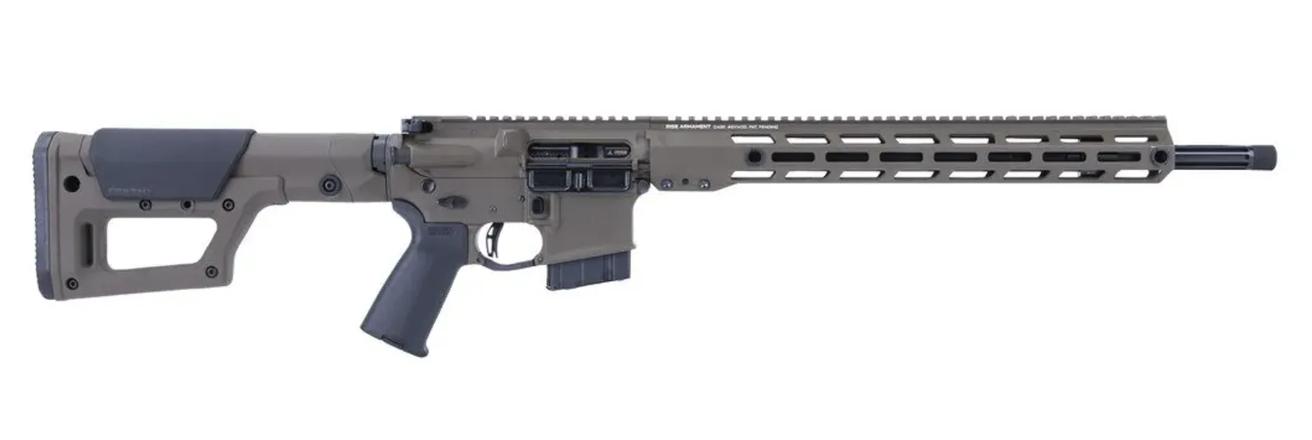
Meeting Straight-Wall Regulations with .350 Legend
In states that mandate straight-wall cartridges for deer hunting, including Ohio, Michigan, and Indiana, the .350 Legend offers a modern AR-15-compatible solution. Firing .357-inch bullets in the 145 to 180 grain range, it delivers muzzle energy approaching 1,800 foot-pounds and remains effective out to roughly 200 to 250 yards.
Conversion from a .223 or 5.56 setup requires a new barrel and dedicated magazines, though many builds do not require a bolt change. Recoil remains manageable, making it a practical option for regulated hunting environments when looking for a new AR-15 rifle calibers.
AR-15 Rifle Calibers – Heavy-Hitting Options for Big Game
For shooters seeking maximum impact at close to moderate ranges, big-bore AR-15 rifle calibers deliver substantial stopping power. The .450 Bushmaster launches .452-inch bullets from roughly 245 to 395 grains, producing more than 2,500 foot-pounds of energy from a 16-inch barrel. It excels on whitetail, hogs, and black bear within approximately 200 to 250 yards.
The .458 SOCOM offers similar performance with a bottlenecked case that can improve feeding reliability. Both cartridges require a new barrel, bolt, and modified or dedicated magazines to ensure consistent cycling.
Additional AR-15 rifle Calibers
Pistol-caliber AR options, such as 9mm, use dedicated uppers and handgun magazines for low-recoil training and ammunition compatibility with sidearms. A .22 LR conversion kit provides an affordable way to practice fundamentals by swapping the bolt and using rimfire magazines, with no barrel change required. That said, there are ton of additional AR-15 rifle calibers out there. While we’ve addressed the most common ones above, the list below is a bit more thorough. If you’d like more details on any of these, let us know and we’ll get something written up.
| Caliber | Use Case | Recoil | Effective Range | Ammo Cost | Special Notes |
|---|---|---|---|---|---|
| 5.56 NATO / .223 | General use, defense, training | Light | 500–600 yds | Low | Most common; uses standard mags and BCG |
| .223 Wylde | Precision, flexibility | Light | 600+ yds | Low | Shoots .223 and 5.56 with improved accuracy |
| .300 Blackout | Suppressed, CQB, home defense | Medium | ~200 yds | Medium-High | Needs a longer barrel and proper twist rate |
| 6.5 Grendel | Hunting, long-range precision | Medium | 600–800 yds | High | Requires Grendel-specific mags |
| 6.8 SPC | Tactical, barrier penetration | Medium | ~500 yds | High | It needs more energy than 5.56; it needs dedicated mags/bolt |
| 7.62x39mm | Budget hunting, close quarters | Medium | ~300 yds | Low-Med | Uses AK mags or AR-specific mags; proprietary BCG |
| 9mm Luger | PCCs, training, indoor shooting | Very Low | ~100 yds | Low | Blowback operated; ideal for pistol builds |
| .224 Valkyrie | Long-range competition | Medium | 1000+ yds | High | Needs a longer barrel and a proper twist rate |
| .22 LR | Training, plinking, small game | Very Low | ~100 yds | Very Low | Requires dedicated upper or conversion kit |
| 5.45x39mm | Budget training, light recoil | Light | ~400 yds | Medium | AK alternative; parts availability varies |
| .458 SOCOM | Big game hunting, barrier use | Heavy | ~150 yds | High | Massive energy; uses modified standard mags |
| .50 Beowulf | Vehicle stops, dangerous game | Very Heavy | ~150 yds | Very High | Extreme stopping power; very specialized |
| .350 Legend | Deer hunting (straight-wall) | Medium | ~250 yds | Medium | Legal in many restricted states |
| .450 Bushmaster | Brush hunting, straight-wall | Heavy | ~200 yds | High | Excellent for big game; thumper performance |
| .40 S&W | PCCs, close-range defense | Medium | ~75 yds | Medium | Less common; requires dedicated components |
| 10mm Auto | Hunting, defense in PCC format | Medium-High | ~100–150 yds | High | Powerful PCC option; ideal for woods carry |
| .17 HMR | Small game, varmint control | Very Low | ~150 yds | Medium | Requires dedicated upper; very flat trajectory |
| 6mm ARC | Long-range, precision | Medium | 700–1000 yds | High | Ballistically efficient; relatively new caliber |
| .204 Ruger | Varmint, precision | Light | ~500 yds | Medium-High | High velocity, flat shooting |
Final Thoughts
The AR-15 thrives on its ability to evolve through targeted upgrades, most commonly a barrel swap and, in some cases, a bolt or magazine change. Beginning with .223 or 5.56 builds skill affordably and reliably, while exploring calibers like .300 Blackout, 6.5 Grendel, or straight-wall hunting options unlocks performance tailored to specific needs.
At Dirty Bird Guns & Ammo, our selection of uppers, barrels, and components makes these transitions straightforward, ensuring your rifle delivers the accuracy, durability, and performance you expect. The platform’s enduring appeal lies in its unmatched flexibility within a single, cohesive system.