

 Dirty Bird Bakersfield
Glock, Handguns, Hunting, Hunting 2025, Hunting Guide 2025, Pistols
The Glock 20: A Comprehensive Overview of the Full-Size 10mm Standard
Nov
Table of Contents
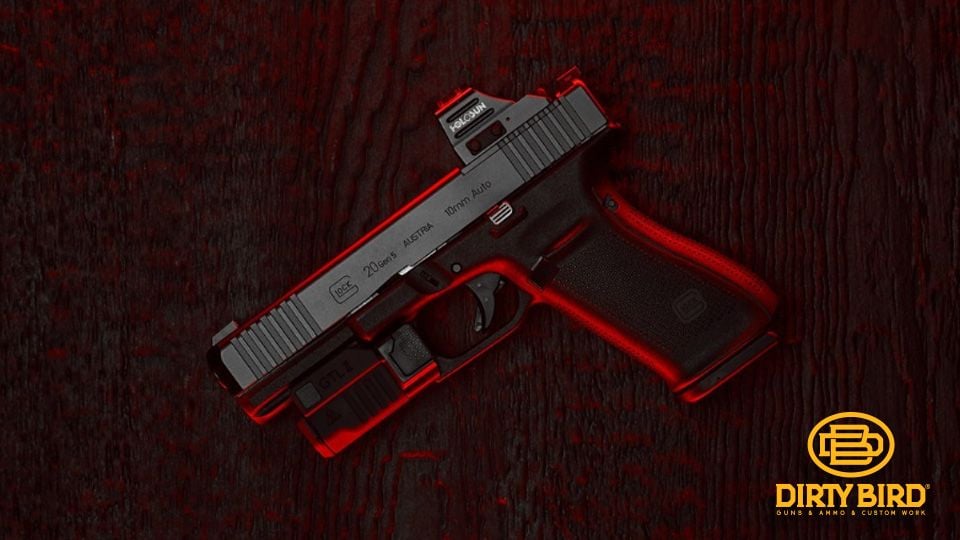
If I was walking thru the woods or the middle of nowhere and thought a bear or mountain lion was stalking me…or a bigfoot, you best believe I’d be reaching for my Gen 5 Glock 20 loaded with some old school Silvertips and topped with a green dot Holosun 509T. It’s not a handgun I carry regularly, but it most certainly comes out of the safe on my yearly fishing trip in the back country (sometimes in the winter under a heavy coat)…and there’s a good reason why.
The bottom line is that specific environments demand more than standard 9mm performance. For backcountry travelers, hunters, and rural residents facing large predators or barriers, the Glock 20 provides unmatched stopping power in a reliable package. Introduced in 1991 and updated across generations, this full-size 10mm Auto pistol remains a cornerstone of Glock’s large-frame lineup. At Dirty Bird Guns & Ammo, we regularly guide customers toward the G20 when power, versatility, and durability are non-negotiable.
This article covers the Glock 20 in depth: its design, performance, reception, and sustained relevance. We include the history of the 10mm cartridge, its popularity in bear country, and comparisons to the Glock 17 and Glock 21 to clarify selection criteria.
Historical Context and the 10mm Cartridge
Glock began in 1963 under Gaston Glock, an engineer producing industrial parts. The company entered firearms in 1982 with the Glock 17, a polymer-framed 9mm that won the Austrian military contract and reshaped handgun standards.
The 10mm Auto emerged in 1983, developed by Jeff Cooper and Norma as a high-velocity alternative to the .45 ACP. FBI trials in 1989 exposed limitations of common law enforcement loads after the Miami shootout, and the Bureau ultimately adopted the .40 S&W in 1990 because full-power 10mm loads were difficult for many agents to control. Commercial interest in 10mm declined after that shift, and ammunition became scarcer and pricier, leaving the cartridge primarily with enthusiasts.
Glock introduced the G20 in 1991 to support the original caliber in a high-capacity semi-automatic. Early adoption was slow, but hunters and rural users recognized its magnum-level energy in a 15-round package. Gen3, Gen4, and Gen5 updates added modular backstraps, improved barrels, and optics readiness. A 10mm revival began in the 2010s with new loads from specialty manufacturers. Today, the G20 anchors Glock’s 10mm family alongside the compact G29 and the long-slide G40.
Why the Glock 20 Dominates in Bear Country
Alaska, Montana, and other bear-rich regions elevate the G20 to essential status. Black and grizzly bears require deep-penetrating, high-energy rounds to reach vital organs through thick hide and heavy bone. Standard 9mm and .40 often underperform in those scenarios. Hard-cast 200-grain 10mm loads at roughly 1,200 fps deliver energy figures that rival many .44 Magnum revolvers while allowing faster follow-up shots.
Field reports and guide accounts support the cartridge’s effectiveness. The G20’s 15+1 capacity exceeds typical revolver round counts, and its polymer frame resists moisture and cold. At about 30 ounces unloaded, it is lighter than many magnum revolvers and easier to carry all day in a chest or hip rig. Gen5 MOS models accept red dots for faster sight acquisition in low-light encounters. Hunters also favor long-barrel 10mm platforms like the G40 for states that permit handgun hunting for large game.
Design and Technical Specifications
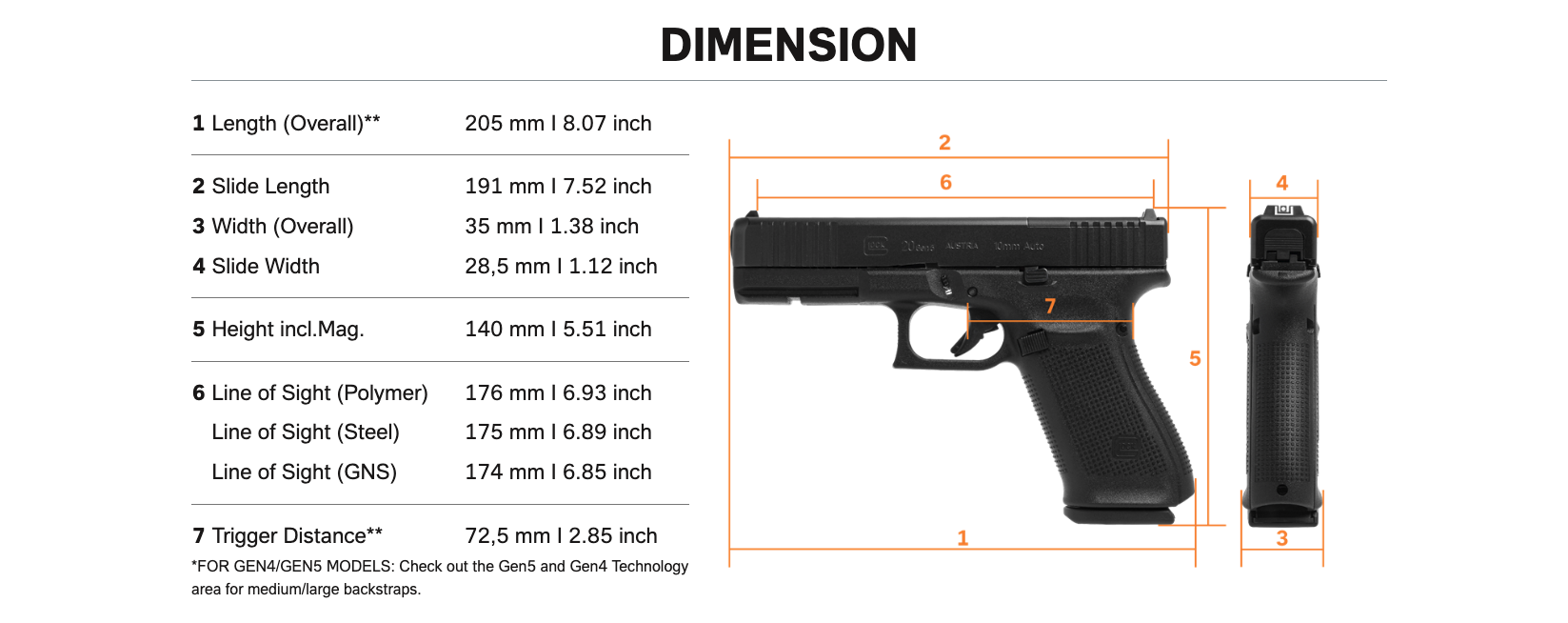
The Glock 20 is built for sustained power delivery. Key measurements and features:
- Overall length: 8.07 inches
- Height (including magazine): 5.51 inches
- Width: 1.34 inches
- Weight (unloaded, with empty magazine): 30.51 ounces
- Barrel length: 4.61 inches
- Standard capacity: 15+1 rounds
The polymer frame features nDLC slide coating and Gen5 texturing without finger grooves. Interchangeable backstraps ensure fit across hand sizes. The slide treatment provides corrosion resistance. Internally, the Safe Action system yields a roughly 5.5-pound trigger pull on factory examples, polygonal rifling is typical, and a reinforced dual recoil spring manages 10mm pressures. Sights are often fixed steel or polymer; steel or night sights are easily installed. The Gen5 MOS variant accepts optics plates. An accessory rail supports lights and lasers. Maintenance involves simple field-stripping and routine lubrication.
Range Performance and Reliability
Range testing validates the G20’s capabilities. Typical quality 10mm defensive loads produce tight 25-yard groups for an experienced shooter and deliver high energy at the muzzle. Recoil is firm but manageable thanks to the frame mass and grip geometry, and practiced shooters can achieve reliable follow-up shots.
Durability testing with mixed ammunition types often shows the platform handles extended runs without stoppages when properly maintained. The pistol can be converted to .40 S&W with a barrel swap and appropriate magazines for shooters who want reduced recoil or more common ammo choices. Common upgrades include improved triggers, extended magazines, and threaded barrels for suppressor use. Typical street pricing for a new G20 ranges in the mid hundreds, offering magnum-level performance at a moderate cost compared with specialty handguns.
Market Reception and User Feedback
Initial interest in the G20 centered on law enforcement and hunting niches. Modern reviews tend to be strongly positive. Owners praise reliability, terminal performance, and the platform’s versatility. Online forums and owner reports highlight real-world stops and hunting success stories. Some smaller-stature shooters note that Gen5 backstrap options improve control. Criticisms focus on ammunition cost and the pistol’s size for urban concealed carry. For those trade-offs, many owners choose an OWB holster or reserve the G20 as a dedicated outdoors or truck gun.
Long-Term Relevance in the Glock Lineup
Despite the 10mm’s earlier commercial decline, the G20 maintains relevance through specialized demand. Bear defense, hunting, and rural defense sustain consistent sales. Glock supports the platform with current-generation models, optics-ready slides, and aftermarket accessories. Conversions and caliber-flexible barrels add to its utility. Resale values for well-kept G20s remain healthy, and component availability is strong compared with many boutique magnum handguns.
The cartridge’s revival through boutique loads and renewed interest among outdoorsmen has made 10mm more accessible. In a lineup dominated by 9mm options, the G20 fills a distinct role for users who require maximum terminal performance from a semi-automatic pistol.
Glock 20 vs Glock 17 vs Glock 21: Decision Guidance
- Glock 17: The 9mm standard. Lower recoil, higher capacity in a smaller package for training, duty, and urban use. Ideal for shooters who prioritize common ammo and manageable recoil.
- Glock 21: Chambers .45 ACP in a similar large frame. Softer perceived recoil with heavy subsonic bullets and proven stopping power at slower velocities. Lower magazine capacity than the G20.
- Choose the G20 when energy and penetration matter more than cost and round count. 10mm outperforms 9mm against barriers and large animals. Choose it over the G21 for higher velocity, greater range potential, and higher capacity. Choose the G21 for subsonic terminal performance and softer felt recoil.
Target User Profile
Ideal for:
- Backcountry hikers and guides operating in predator territory
- Hunters needing a versatile sidearm for heavy cover game
- Rural residents concerned about wildlife or structural threats
- Reloaders who want flexibility to develop high-performance loads
Less suitable for:
- Urban concealed carry due to size and weight
- Budget shooters who avoid higher-cost ammunition
- Recoil-sensitive individuals without training
- Competitive shooters focused on ultra-light recoil and high round counts
Conclusion
The Glock 20 delivers 10mm authority in a platform refined across decades. It excels where standard calibers fall short, particularly in bear country and heavy-cover hunting scenarios. For outdoorsmen, guides, and rural residents who value terminal performance and magazine capacity in a semi-automatic, the G20 remains a top choice. Visit Dirty Bird Guns & Ammo to evaluate the G20 in person and to pick up suitable ammunition and magazines for your first range session. The right tool enhances confidence, and for those who need uncompromising power, the Glock 20 fills that role.